How to follow up with a recruiter after applying or interviewing

Have you submitted your CV or attended an interview, then heard nothing? A brief follow-up can help you ask where recruitment stands and restate your interest. It should make your application easy to identify without demanding an immediate answer.
Here is how to choose the timing and channel, with email and WhatsApp templates to adapt when looking for work in Cameroon. The suggested timings are practical guidelines, not rules binding employers or a guarantee of a reply.
1. Check the instructions before following up
Review the advert, your application message and any acknowledgement. Did the recruiter give a response date? Does the advert say only shortlisted applicants will be contacted, or ask candidates not to call? Respect those instructions.
Check that your application was sent successfully: correct recipient, attachment included, form submitted and no delivery failure message. Check your spam folder too. An acknowledgement means the application arrived; it does not mean you have been selected.
On Kamerjob: find the vacancy details again
Use Kamerjob’s job listings or the link saved in your notes to find the role, company, reference and closing date. Read the application instructions in the complete advert. Do not assume that the application deadline is the date when every applicant will receive a decision.
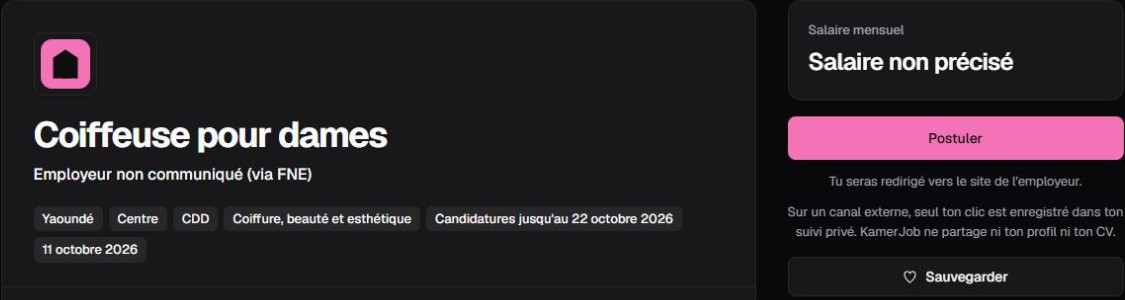
Kamerjob screenshot captured on 17 October 2026, used as a reading guide. It does not mean the vacancy is still open or that a recruitment outcome is known.
Exercise: before writing, note “role — company — reference — submission date — channel used — response timeframe”. These details often make a follow-up easier to handle.
2. Choose a reasonable time and the right channel
After applying: if no timeframe is provided, consider a first follow-up after roughly one to two weeks. If applications are still being collected, wait until the closing date and allow processing time. Adapt this guideline to the procedure and advert instructions.
After an interview: wait for the stated timeframe. If the recruiter expected to reply on Friday, let that deadline and a short additional period pass before asking for news. If no date was given, about a week can be a starting point, depending on the circumstances.
A thank-you message shortly after an interview is not a request for a decision. It can simply express continued interest. If you have a genuine deadline, such as another offer requiring a reply, explain it factually without inventing urgency.
- Email: reply in the existing thread where relevant, or use a clear subject line for a new message.
- WhatsApp: use it if recruitment is already taking place there or the recruiter invited you to do so.
- Phone: favour a call when it is expected or accepted. Introduce yourself and ask whether it is a convenient time.
Avoid searching for an employee’s personal number to bypass the instructions. Do not contact several people at the company on the same day about the same request. If you applied by email, posting on the company’s public page is generally not the best way to track your application.
3. Write a short, specific message that is easy to handle
Your follow-up needs four elements: your identity, the role and application or interview date, a brief reminder of your interest and a question about the next steps. Replace every item in brackets before sending.
Email template after applying
Subject: Application follow-up — [role] — [reference] — [name]
Hello [name or hiring team],
I submitted my application for the [job title] position, reference [reference], on [date]. I remain interested in the [relevant duty] responsibilities.
Could you let me know whether recruitment is still in progress and whether a response timeframe is available? I am happy to provide any additional information.
Thank you for your time. Kind regards, [first name, surname and contact number].
Do not automatically resend several versions of your CV. If requested, attach the current document and clearly identify it as the version to use.
Template after an interview
Hello [name],
Following our interview on [date] for the [job title] position, I am writing to ask about the next steps. Our discussion of [duty actually discussed] confirmed my interest in the role.
You expected to provide an update around [stated date]. Could you let me know whether the timeline has changed? I remain available if you need any further information.
Thank you. Kind regards, [name].
If no date was given, replace that sentence with: “Could you let me know the expected timeline for the next steps?” For future conversations, see our first job interview guide.
WhatsApp version, when this channel is agreed
Hello [name], this is [first name and surname]. I am following up on my application for the [job title] position, submitted on [date]. I remain available and interested. Could you let me know whether recruitment is still in progress? Thank you.
Send the message at a reasonable working hour. Avoid long voice notes, repeated calls and sending “Hello” alone while waiting for a reply. A tick or read receipt does not reveal the recruiter’s decision.
4. Adapt your response to the update you receive
Recruitment is delayed: thank the recruiter and, if needed, ask for a new expected response period. Record it to avoid following up too soon.
“Thank you for the update. I remain interested in the role and available for the next steps. I have noted that an update is expected around [period].”
You have a deadline for another offer: explain politely. The company may be unable to speed up its decision.
“I wanted to let you know that I need to respond to another offer by [actual date]. I remain interested in your position. Would it be possible to update me on my application before then? I understand if your timeline does not allow it.”
Your application is unsuccessful: thank them for letting you know. You can ask for brief advice where appropriate, without disputing the decision or insisting on a detailed explanation.

A useful follow-up asks a specific question and gives the recruiter room to explain their timeline. Illustrative photo: Edmond Dantès / Pexels.
5. If there is no reply, set a limit and keep looking
After an unanswered first follow-up, you may consider one final brief message one to two weeks later if the instructions allow it. This is optional. Beyond that, avoid repeated contact and focus your energy on other applications.
Do not treat silence as a promise of employment. A follow-up does not require the recruiter to reply and cannot replace preparing your application. Keep looking for suitable roles and improving your CV.
Keep a simple record in your phone’s notes: “application sent — interview — response timeframe — follow-up sent — next action”. Our guide to finding work with your phone offers an organising method.
Before sending: check the recipient, role, dates and instructions; remove blame or reproach; ask one clear question. Your aim is to make professional communication easier while continuing your job search.
The templates and timings are guidelines to adapt to each recruitment process. Illustrative photos: Tima Miroshnichenko / Pexels and Edmond Dantès / Pexels. The people pictured are not presented as Kamerjob candidates or recruiters. Screenshot: Kamerjob.
Cover photograph: Ono Kosuki / Pexels. Illustrative image.
The Kamerjob team
Comments
Loading comments…