Already working in the informal sector? How to show the value of your experience

Do you sell at a market, help in a family shop, offer hairdressing at home or learn a trade in a workshop? You may already have experience an employer can use, even without payslips or an official job title. The challenge is to explain exactly what you do, the context and how independently you work.
Showing the value of this experience does not mean inventing a contract, qualification or company. Here is how to present informal work on your CV and in interviews in Cameroon, with examples to adapt to your own background.
1. Take stock of the work you actually do
Start with a page of notes. For each activity, record the period, location, frequency, tasks and people you work with. Explain the arrangement: self-employment, family support, occasional assignments or practical training. Helping two Saturdays a month should not be presented as a full-time job.
Ask yourself: what am I trusted to do? Which tools do I use? What can I do independently? Which tasks still require help? A concrete answer provides more information than “I am hardworking”.
Fictional example: “I help my aunt in her shop three afternoons a week. I welcome customers, arrange products and prepare orders. She checks the till and orders from suppliers.” This already describes useful tasks without claiming responsibilities the applicant does not have.
If you are unsure of dates, look for clues in your notes or messages. Label an approximate period as approximate rather than inventing an exact day. Distinguish regular work from a few isolated assignments.
2. Turn tasks into understandable skills
For each task, identify the skill involved and an example you can explain. Prioritise skills relevant to the vacancy. The following descriptions are templates: use them only if they match your actual work.
- Small-scale retail: “Welcoming customers, explaining products and arranging goods.” Add taking payments or tracking stock only if you actually do those tasks.
- Tailoring: “Taking measurements and completing basic alterations according to customer requests.” Say whether you work under supervision.
- Food service: “Preparing ingredients, setting up the workstation and cleaning as instructed.” Do not claim full responsibility for a kitchen if your role is to assist.
- Learning vehicle maintenance: “Preparing tools and assisting with maintenance under a mechanic’s supervision.” Distinguish tasks you have watched from those you can perform.
A number can make a task more specific, but it must be reliable. If you do not know how many customers you served, leave the figure out. You can describe an actual frequency, such as “opening the stall on Saturdays”, or a responsibility someone can confirm, such as “preparing orders for collection”.

Describe practical skills through tasks, tools and your level of independence. Illustrative photo: Ishaka Ali / Pexels.
3. Present the experience clearly on your CV
You can use a section called “Experience and activities”. Give a clear title, context and period, followed by two or three tasks relevant to the role you want. Explain whether the activity was family-based, independent or occasional. You do not need to invent a company name.
Template for helping a family business
Sales support — family shop, [town]
[Month/year] to [month/year] — [actual frequency]
Welcoming and assisting customers; arranging products; preparing orders under the shop manager’s supervision.
Template for independent services
Mobile hairdresser — self-employed, [town]
Since [month/year] — by appointment
Providing [techniques you actually master]; arranging appointments; preparing and maintaining equipment.
Replace every item in brackets. If the work was voluntary, say so. You can honestly describe a short course or practical training without a diploma, without presenting it as a qualification you have earned.
On Kamerjob: turn your notes into a CV
Open the Kamerjob CV builder and choose the option to create your CV for free. Prepare a title matching your target role, a short introduction and your experience. Use your task inventory and prioritise the duties relevant to the advert.
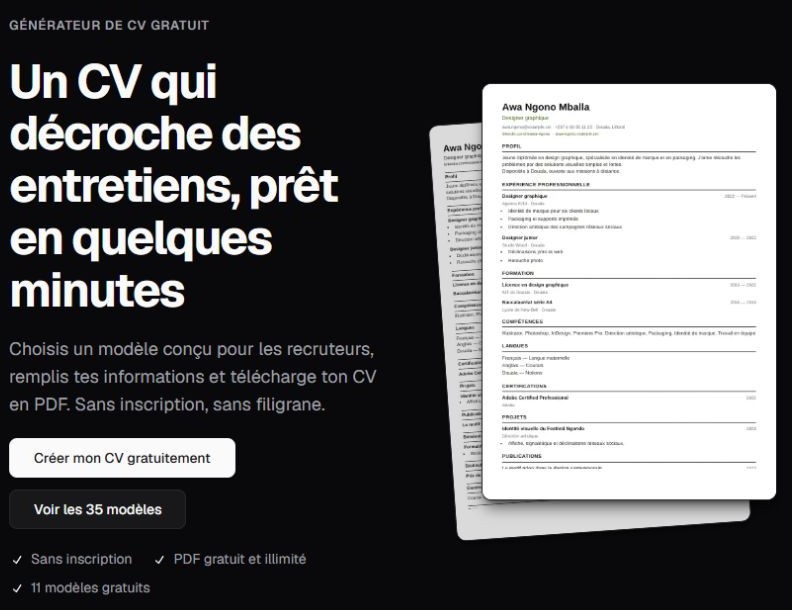
Visual guide: Kamerjob’s CV builder page, captured on 17 October 2026. The screenshot shows the French interface; the layout may change.
Exercise: replace “I do small jobs” with a precise title such as “Sales assistant — family business support”, then add three tasks you actually performed. Review the CV on your phone and check your contact details before sending it. Our guide to creating a CV without qualifications or formal work experience can help you organise the rest.
4. Prepare simple evidence and references who have agreed to help
Experience is easier to explain when you can show an example of your work. Depending on your trade, prepare a few photos of your own work, an anonymised order example or a short recommendation. Ask permission before using a photo taken at a customer’s premises or in a workshop.
Avoid publicly sharing private conversations, customer contact details, till records or people’s faces without permission. A small portfolio only needs a few relevant, clearly explained examples: what you made or did, your exact role and the tools used.
Message to request a reference: “Hello [name], I am applying for a [role] position. Would you be willing to confirm the tasks I carried out with you if a recruiter contacts you? May I give them your phone number? Thank you.”
Wait for agreement and check their availability. Someone can confirm that you worked together without being your employer. Describe their actual relationship to you. Do not fabricate a certificate or ask someone to pretend they employed you.
5. Explain your background confidently in an interview
Prepare a short introduction: your activity, two relevant tasks, a specific example and what you want to learn. You do not need to put down your experience or hide its limits.
Fictional example for a sales role: “I gained experience helping in a family shop. I welcomed customers and prepared orders three afternoons a week. When a product was unavailable, I told the manager before confirming the order. I now want to learn your product range and stock-tracking method.”
If you are asked for a payslip or work certificate you do not have, answer clearly: “This was work in a family business, and I do not have that document. I can explain my duties and, with their permission, provide the contact details of the person I worked with.”
Your experience can be relevant without replacing a mandatory qualification or a specific job requirement. In Kamerjob’s job listings, compare your skills with the duties and requirements. Identify what you can already do and any training you may still need.
Do this today: choose one activity, write down three tasks, prepare one CV entry and ask someone whether they would be willing to confirm your work. You will have a concrete starting point for your next application.
The examples in this guide are fictional and should be adapted. Illustrative photos: Victor Oluwayoju / Pexels (cover) and Ishaka Ali / Pexels. The photographs do not establish the subjects’ qualifications or employment status and are not presented as having been taken in Cameroon. Screenshot: Kamerjob.
The Kamerjob team
Comments
Loading comments…