Can your TikTok account serve as a CV?

Your TikTok account can help a recruiter discover your work, especially for content creation, editing or communication roles. But a video feed does not always explain dates, your exact contribution, availability and skills as clearly as a CV. Use it as evidence of your work while respecting the documents requested in the vacancy.
A useful application often combines a readable CV, selected videos and an explanation of your contribution. Here is how to prepare that package in Cameroon, even with a small audience.
1. Identify what the recruiter needs to assess
Review the duties before sending your profile. Does the role involve writing, filming, editing, presenting to camera or community management? Your videos should demonstrate relevant tasks. An entertaining account does not automatically establish that you can follow a business brief.
A CV summarises your background and declared skills. A portfolio shows examples. Your TikTok account can host some of those examples, but may also contain unrelated posts. Make the recruiter’s selection easier instead of asking them to browse everything.
Fictional example: for a video editing role, send a piece you edited and explain your pacing and subtitle choices. A video in which you only appear as presenter does not prove that you edited it.
If the advert requests a CV and letter, provide them. Add links as supporting material unless the process explicitly asks for another application format.
2. Select three videos and explain your role
Choose a small selection suited to the job: a product demonstration, short interview and explanatory video, for example. Variety matters only when each piece demonstrates a useful skill. A clear project is preferable to many unexplained links.
For each video, record four details: objective, context, contribution and learning. Say whether it was personal, voluntary or commissioned work. Do not list a brand as a client without an actual collaboration.
Entry to adapt: “Video: [title and link]. Personal project, not commissioned. Objective: explain [use] to [audience]. My role: script and editing; filming by [collaborator’s role]. Improvement: shorter subtitles and a demonstration at the start.”
For teamwork, explain who did what. If you use supplied footage, sounds or other materials, check that you may show them in this context. Obtain necessary agreement before sharing client work and hide confidential information.

A video becomes more useful evidence when your contribution is clearly explained. Illustrative photo: George Milton / Pexels.
3. Prepare a professional profile without exposing private information
Choose an identifiable name and a short introduction reflecting your actual work. You can separate a professional presentation space from personal use without treating public access to your entire life as a requirement for applying.
Possible introduction: “Short-form video creation in [town]. Scripts, smartphone filming and editing. Personal projects and portfolio: [link if available]. Professional contact: [dedicated address].”
Do not publish your full home address, identity documents or customer contact details in your bio. Recruiters do not need your password or login code to review your work.
Test your links without being signed into your own account, preferably on another device. Access may vary with settings and the reader’s environment. Provide an authorised alternative: a portfolio page, view-only folder or PDF describing projects with accessible links. Do not bypass platform restrictions.
Keep a copy of your own files. If a video becomes unavailable, its description and other application documents should still make your work understandable.
4. Connect the account to a CV and specific application
Use an accurate CV heading such as “Video content creation — personal projects”. Include the period and two or three tasks you perform. Add a readable portfolio link; a QR code can complement it but should not be the only access route.
Example entry: “Since [month/year] — Personal short-form video projects. Script preparation, smartphone filming and editing with [tool you know]. Three selected projects with my contribution explained: [link].”
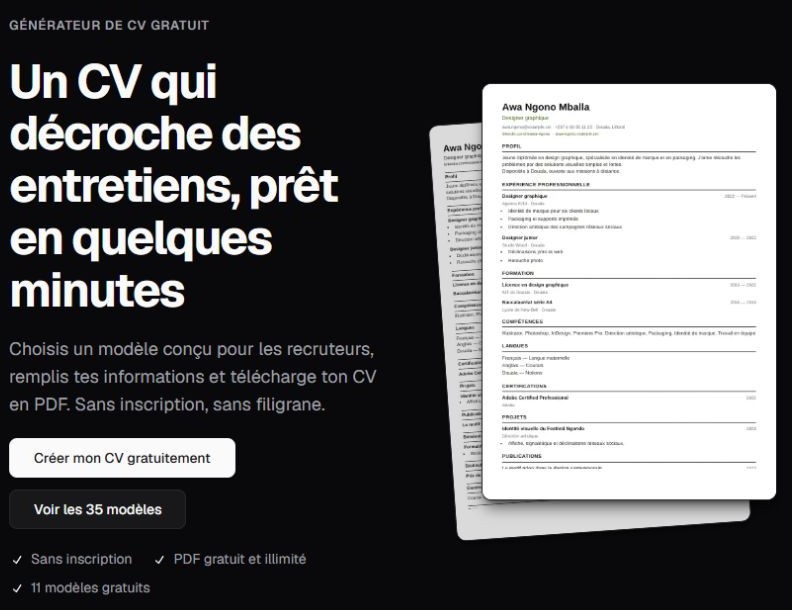
The Kamerjob CV builder can help structure the background accompanying your videos. Screenshot captured on 17 October 2026; the interface may change.
In Kamerjob’s vacancies, compare duties with your projects before selecting links. Our TikTok creator skills article examines actual listings, including a closed vacancy, to help you practise.
Application message: “Hello [name], I am applying for [job title/reference]. My CV is attached. Here are three videos demonstrating [requested skills]: [portfolio link]. Each project explains my role. I am available to discuss my approach. Thank you, [name].”
5. Put figures in context
A small audience does not prevent you from showing careful framing, clear editing or a good explanation. Conversely, a widely viewed post does not establish every skill required for a job.
When presenting statistics, specify the period, source and any paid promotion. Distinguish views, interactions and business outcomes. Do not promise sales based on views without tracking that supports the connection.
Fictional example: “The account statistics show 2,800 views over seven days, without paid promotion. I do not have sales data. I mainly used viewers’ questions to plan a follow-up explainer.”
In an interview, describe a difficulty and what you changed too. An honest explanation of your process is more useful than a promise of virality. To improve future work, see our guide to creating business videos with your phone.
Your five preparation steps: review the vacancy, select three videos, explain your role, check access and attach the requested documents. Your account can then support your application without making the recruiter guess your background.
The introductions and figures are fictional examples to adapt. Illustrative photos: Tima Miroshnichenko / Pexels and George Milton / Pexels. The people pictured are not presented as Kamerjob candidates or employees. Screenshot: Kamerjob.
Cover photograph: RDNE Stock project / Pexels. Illustrative image.
The Kamerjob team
Comments
Loading comments…