Types of Employment Contract in Cameroon: The Guide Before You Sign

Fixed-term, permanent, temporary agency work, internship… A vacancy interests you, but do you know exactly what the contract on offer involves? Before committing, take the time to understand how long the relationship will last, the pay on offer and the conditions for leaving. The right reflex: ask your questions before you sign.
This guide to the types of employment contract in Cameroon helps you read job offers with more perspective and prepare your discussion with the recruiter. It mainly covers employment governed by the Labour Code; some public-sector staff fall under specific statutes.
1. Permanent and fixed-term: the two main forms of employment contract
The permanent contract (CDI): building a long-term relationship
A contract of indefinite duration has no end date. Ending it is still governed by the applicable rules, particularly regarding notice.
Example: a company in Douala is hiring an accountant to support its business over the long term. During the interview, ask how onboarding, appraisals and career progression work.
What to check: the actual duties, place of work, basic salary, bonuses and mobility conditions. The prospect of stability also deserves clear day-to-day commitments.
The fixed-term contract (CDD): knowing the end date from the start
A fixed-term contract sets its end date in advance. The Code provides for a maximum duration of two years, renewable for the same duration. For a Cameroonian worker in the same company, only one renewal is allowed; if the relationship continues after that, it becomes a permanent contract. Contracts tied to a specific piece of work or to a precisely stated future event that is certain to occur are treated as non-renewable fixed-term contracts. Special arrangements exist for temporary, casual and seasonal jobs.
Example: an association in Yaoundé offers a position for a twelve-month project. Ask what end date appears in the contract and how the team plans for the end of the project. A possible renewal mentioned verbally is not a promise of long-term employment.
Reference: section 25 of the Cameroon Labour Code.
2. Temporary, casual or seasonal work: understanding the assignment
These jobs meet different needs: replacement or extra help for a piece of work, an unforeseen increase in activity or urgent work, cyclical or weather-dependent activity. Temporary agency work goes through a temporary employment agency; the contract with the worker placed on assignment must be in writing.
To compare two assignments, look beyond the number of days announced. Who is hiring you? Who pays you? Who do you report an absence to? Who provides the necessary equipment? These answers should be clear before your first day.
- Replacement: ask for the position you will fill and the reason for the assignment to be specified.
- Short-term reinforcement: ask for the schedule, the expected tasks and how you will be paid.
- Seasonal work: plan your travel and your next job search ahead of time.
References: sections 25 and 26 of the Labour Code.
3. Internship, apprenticeship and freelancing: frameworks to tell apart
The internship: defining what you will learn
If you are looking for a first experience, ask for a document that sets out the learning objectives, dates, supervisor, working hours and any allowance. Also ask what document you will receive at the end: a certificate, an evaluation or an approved report.
The useful question: "What skills should I have acquired by the end of this internship?" A concrete answer will help you judge the value of the experience. Any job offer afterwards should be discussed separately.
The apprenticeship: learning a trade with supervision
For an apprenticeship in a workshop, a company or another workplace, ask who will train you, with what tools and following what progression. Clarify any fees, the working hours, safety conditions and how your progress will be assessed. See the framework that applies to apprenticeships in the Labour Code, from section 45 onwards.
Independent services: scoping a deliverable
A freelance assignment is built around a result: creating a website, taking photographs or producing a communication campaign, for example. Before quoting a price, describe the deliverables, deadlines, approval stages and the number of revisions included.
Also agree on the deposit, the final payment and the rights to use your work. The "freelance" label alone does not determine the legal nature of a relationship: the actual working conditions count. Section 23 defines salaried employment as activity carried out under an employer's authority in return for pay.

Reading the terms and asking questions before signing. Photo: Edmond Dantès / Pexels.
4. Before you sign: the questions that change everything
Keep this list to hand for your next interview. Write down the answers and ask for the points agreed to be included in the documents you receive.
- Who is hiring me? Check the employer's name and the identity of the person you are dealing with.
- For what duties? Ask for a job description and who your line manager will be.
- For how long? Clarify the start date, any end date and the conditions for renewal.
- For what pay? Distinguish gross pay, estimated net pay, bonuses, commissions and expense reimbursements.
- On what schedule? Ask about working hours, rest days, travel and place of posting.
- With what formalities? Ask the employer about social security registration, payslips and the documents you will receive.
- How does the relationship end? Ask which procedures and notice periods apply.
Advice from the Kamerjob team: take the time to read every page, ask for an explanation of any unclear clause and keep your copy along with any important correspondence.
If a probation period is offered, ask for its length, whether it can be renewed and the assessment criteria. Don't settle for a phrase like "we'll see after the trial period".
Practical example: find and read a fixed-term vacancy on Kamerjob
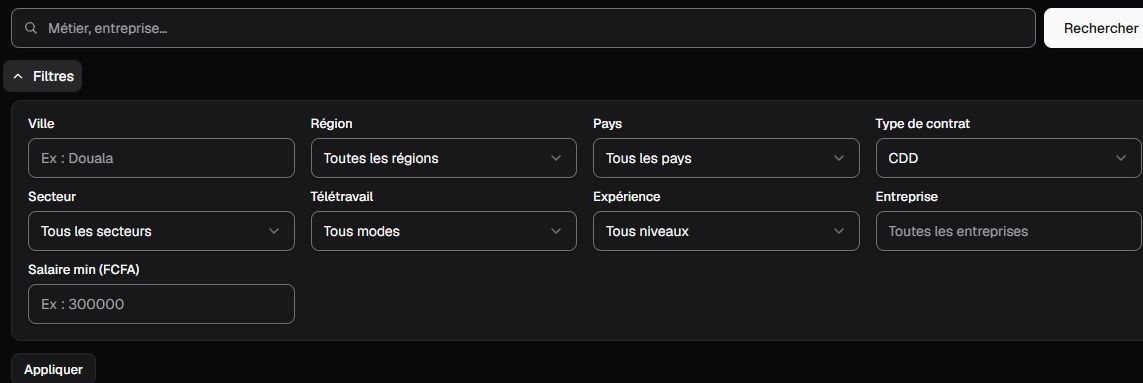
Open the job listings, expand Filters, choose a fixed-term contract under Contract type, then apply the filter. The screenshots below show the French interface, where fixed-term contracts are labelled CDD.
Open a vacancy and look for the contract badge near the location and application deadline. In this example, the “Coiffeuse pour dames” vacancy shows CDD. The application panel explains that the next step takes place on an external website.
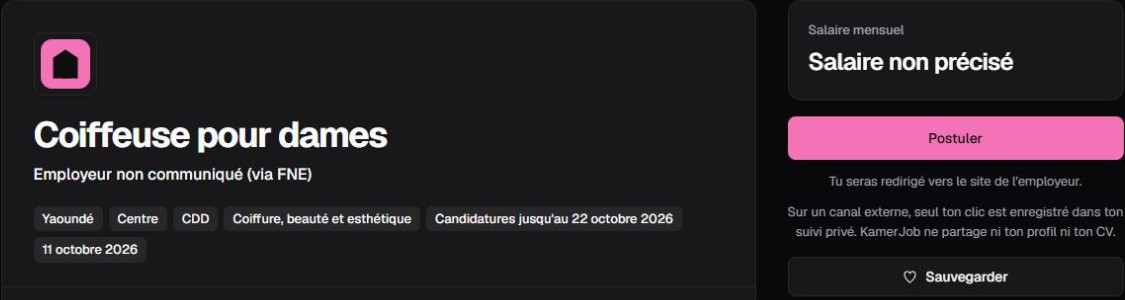
Questions to ask: what is the exact contract duration, the salary and payment frequency, and the renewal arrangement? A badge does not provide every answer. “Salary not disclosed” means you need to clarify the pay; it does not mean the work is unpaid.
“Full-time” and “part-time” describe working hours; still check whether the legal arrangement is a fixed-term or open-ended contract. If the contract is unspecified, ask the recruiter to clarify it.
Kamerjob screenshots taken on 17 October 2026. They illustrate navigation, not an endorsement of an employer or a guarantee that a vacancy remains open.
5. Choosing an opportunity that fits your plans
Looking for a steady income? Examine long-term positions and their overall pay. Want to discover a sector? A defined assignment can let you try out the tasks that interest you. Just starting out? Look closely at the quality of supervision and the skills you will then be able to highlight on your CV.
Compare the content of the work, the commute, the schedule and the prospects on offer. A contract title never tells the whole story of the experience you are about to have.
Ready for the next step? Browse job offers on Kamerjob, spot the opportunities that suit your profile and prepare your questions before you apply. Also see our tips for your CV and cover letter.
Sources: Law No. 92/007 of 14 August 1992 on the Labour Code, in particular sections 23 to 28 and 45 et seq., consulted on 17 October 2026 via the International Labour Organization. Collective agreements and implementing regulations may set out the rules more precisely depending on the situation. For a problem with your own contract, contact the labour inspectorate or a legal professional.
Photo credits: Kaboompics.com / Pexels and Edmond Dantès / Pexels. Illustrative photos.
The Kamerjob team
Comments
Loading comments…