Finding your first legal job in Cameroon: where should you start?

Finishing a law degree or seeking your first legal job in Cameroon? Start by identifying duties suited to your level, then prepare concrete evidence of research, writing and case-organisation skills. Qualifications matter, but employers also need to understand what you can contribute with the planned supervision.
The Kamerjob adverts cited were checked on 18 October 2026. They are examples: confirm availability and conditions with the recruiter or original application page.
1. Choose two or three relevant routes
Depending on training and experience, target legal internships, legal assistant roles, junior legal positions or some combined legal and tax roles. In companies, examine contracts, research, disputes and administrative follow-up. In a law firm, clarify expected support and who will supervise you.
Do not treat jurist, lawyer and notary titles as interchangeable. A law degree alone does not establish all professional qualifications and authorisations required for every function. Read the vacancy and verify requirements for the profession concerned.
Fictional example: “With a degree in private law, I am targeting business-law internships and legal assistant roles in Douala. I want to develop research, drafting and file-management skills under supervision.”
2. Read requirements beyond the title
The Chicaparts Africa vacancy in Yaoundé lists Bac+3 to Bac+5 qualifications and accepts beginners. It combines contracts, disputes, debt recovery and legal monitoring, requiring knowledge of French and Cameroonian law. Prepare relevant examples and explain your knowledge honestly.
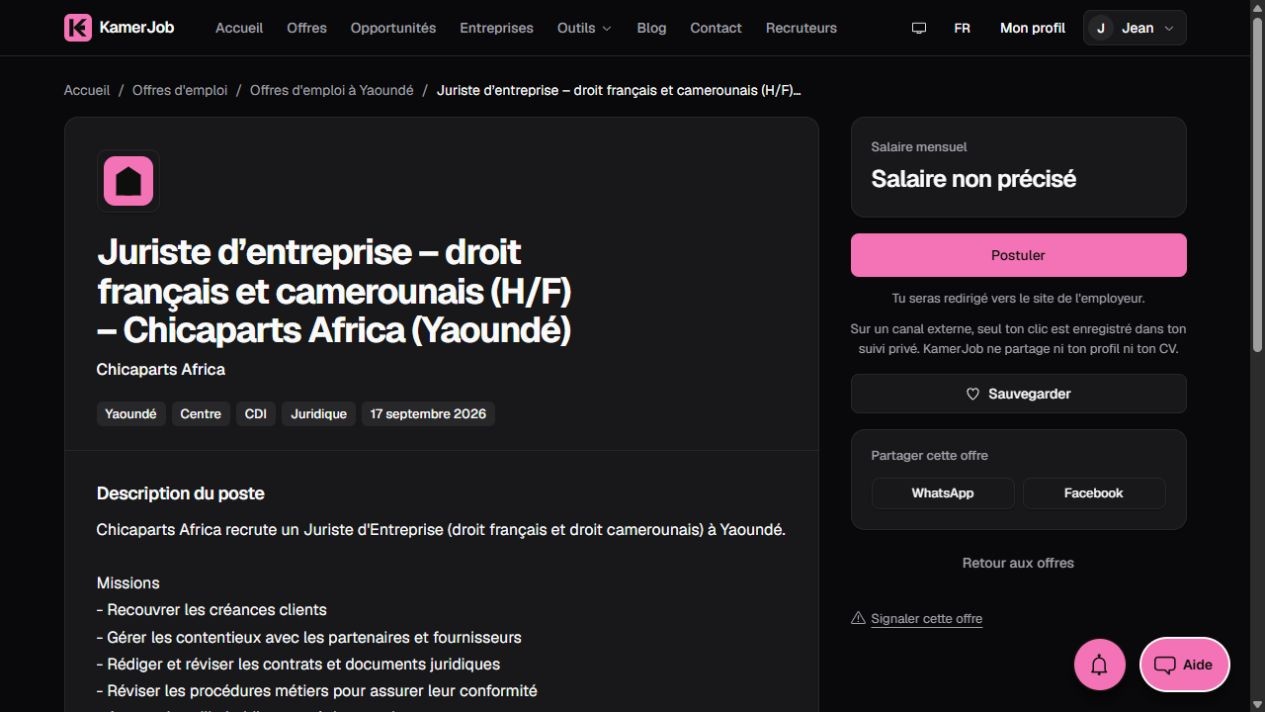
Screenshot dated 18 October 2026. Accepting beginners does not remove other requirements.
In contrast, the OFI legal and tax assistant internship in Douala asks for a degree or equivalent and at least two years of accumulated professional internships. It mentions tax, business and OHADA law, and French and English communication. “Internship” does not always mean first experience.
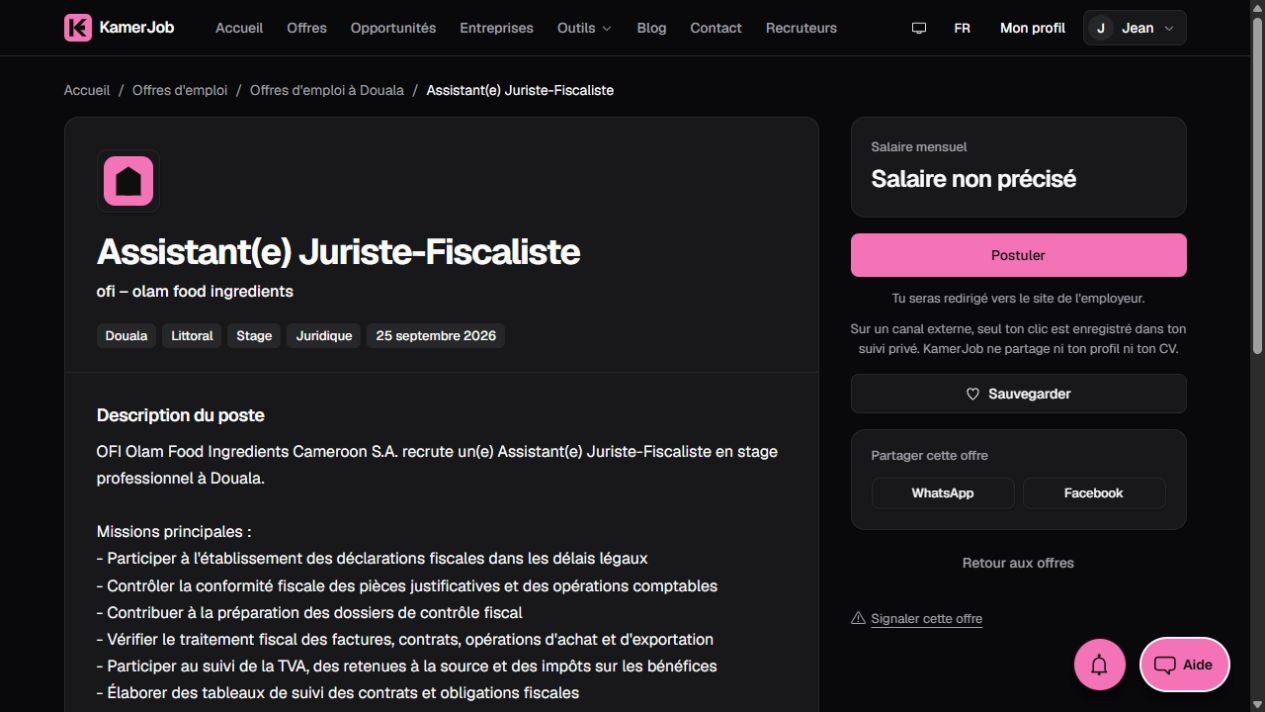
Screenshot dated 18 October 2026. Compare requirements with your background. Both screenshots retain the French interface.
3. Turn your background into observable skills
State your qualification, relevant subjects, internships, academic projects and actual activities. For each experience, explain a task, your contribution and review arrangements. Do not turn observation into independent responsibility.
Adaptable example: “Law-firm internship — documentary research and draft correspondence reviewed by my supervisor; organising documents and updating a tracking spreadsheet.”
Without an internship, present a dissertation, case study or group assignment as academic work. Explain the question, method and personal contribution. Do not invent clients, proceedings or results.
4. Prepare two work samples
Create a short research note and tracking table using a fictional case. A note can identify the question, official sources consulted, dates, points to verify and a cautious conclusion. A table can track missing documents, reviewers and fictional deadlines.

Illustrative photograph: RDNE Stock project / Pexels.
These exercises demonstrate a method; they are not legal advice for a client. Do not share confidential contracts, identities or files from an internship. Real documents require appropriate permission and protections; a fully fictional case is often simpler.
5. Personalise your application
Browse Kamerjob legal vacancies, also searching “stagiaire juriste”, “assistant juridique”, “juriste junior” and your specialism. Compare duties, location, experience and application channel. Some listings link to external sites: follow the specified procedure.
Template: “Hello, I am applying for [role]. With [qualification], I completed [relevant internship/project], where I worked on [specific task]. I would like to contribute to [advertised duty] with the planned supervision. Please find my CV and [requested document].”
Use a precise subject line, readable CV and clearly named files. Send only relevant or requested documents. Do not pay an unverified contact to guarantee selection.
6. Prepare for interviews and clarify conditions
Practise explaining how you approach an unfamiliar question: clarify facts, research applicable texts, check currency and submit your analysis to the appropriate reviewer. If you do not know an answer, explain how you would verify it rather than improvising.
- What are my initial duties and who reviews my work?
- Which tools, languages and areas of law will I use?
- What duration, hours and pay or allowance are planned?
- How will progress be evaluated?
Record applications and next actions. Follow up reasonably after discussions, naming the role and application date. A first opportunity should help demonstrate accuracy and develop skills, with conditions understood before starting.
Cover: Christina Morillo / Pexels. Stock photographs unrelated to recruiters. Screenshots: Kamerjob, 18 October 2026. Examples are fictional.
The Kamerjob team
Comments
Loading comments…