How to prepare for your first job interview in Cameroon

Have you been invited to your first job interview? It is a chance to explain what you can do, show how you learn and understand the role on offer. You do not need a perfect speech: prepare honest answers, specific examples and a few useful questions.
Whether you are applying to a shop, workshop, restaurant or office in Cameroon, this approach will help you prepare. The examples below are fictional: adapt them to your background and the advertised duties.
1. Confirm the arrangements and review the vacancy
Confirm the date, time, exact address, whom to ask for and format: in person, by phone or by video. Ask which documents to bring. Plan your journey and allow enough time to arrive a few minutes early. Clean clothing appropriate to the role is enough; avoid financial pressure to buy expensive clothes.
Confirmation message: “Hello [name], thank you for inviting me. I confirm my availability for the interview on [date] at [time] for the [job title] position. Could you please confirm [the exact address / the meeting link] and any documents I should prepare? Thank you.”
Review the CV you submitted. Be ready to explain each activity, period and skill listed. Keep an accessible copy on your phone and bring a printed version if requested and practical.
On Kamerjob: connect your background to three job requirements
Find the advert through Kamerjob’s job listings. Write down three important duties and, for each, an example of something you have done or something you need to learn. Check the location, contract type and advertised conditions too.
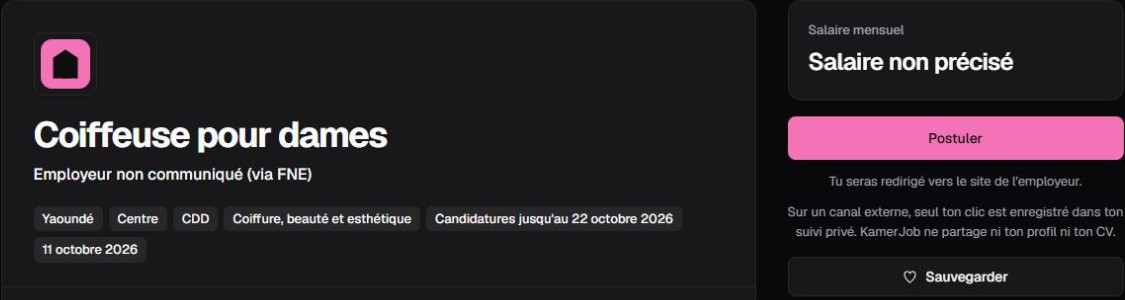
Kamerjob screenshot captured on 17 October 2026, used as a reading guide. The vacancy pictured may no longer be open.
Exercise: for a sales role, write “customer service → I welcomed customers in a family shop” and “stock tracking → I can arrange products, but I need to learn the software”. This prepares specific answers without overstating your skills.
2. Introduce yourself with facts in about a minute
When asked “Tell me about yourself”, focus on the role. Describe your work or training, two relevant skills and what you are looking for. An opening answer of about a minute leaves room for follow-up questions.
Example for someone starting in sales: “My name is [name]. I helped in a family shop for [actual period], welcoming customers and preparing orders. This taught me to listen to requests and check products before handing them over. I would now like to work in sales and learn your till and stock-tracking procedures.”
If you have no work experience, choose a real activity: a school project, volunteering, practical training or regular help you provided. Explain the context. Do not present an occasional favour as paid employment. Our guide to showing the value of informal work experience can help you find the right words.
Practise aloud with someone you trust, or record yourself to listen back. Remember the main ideas rather than memorising a script. If you lose your train of thought, pause and start again calmly.
3. Answer questions with a specific example
An answer is more convincing when you describe a real situation: what was the problem, what did you do and what happened? You can finish with what you learnt. There is no need to invent numbers or a spectacular success.
“Why do you want this job?”
“The customer service and order preparation duties match tasks I have started practising. I want to develop in an organised workplace and learn your approach. The location is also compatible with my journey to work.”
Base your answer on information actually included in the advert or verified about the company. Avoid generic praise you could not explain.
“Tell me about a difficult situation you handled”
“A customer wanted a product that was out of stock. I checked with the manager before suggesting an alternative. The customer could then choose knowing the difference. I learnt to check availability rather than promise an item we do not have.”
“What do you need to improve?”
“I still need practice with stock-management software. I am comfortable recording quantities on a sheet, but I would need a demonstration of your system. I take notes and ask for my first entries to be checked.”
Choose a genuine limitation and explain how you work to improve. If you do not understand a question, ask for it to be rephrased. If you cannot perform a task, say so clearly, especially where it involves risk or requires a qualification.
In a bilingual setting, describe your actual level in English and French. If the interview changes language, ask for clarification when needed. You can prepare a short introduction in both languages without claiming equal fluency.
4. Ask questions and clarify the conditions
The interview also helps you decide whether the role suits you. Prepare two or three questions the advert has not answered:
- Which duties will take priority during the first few weeks?
- Who will help me get started, and whom will I report to?
- What are the usual workplace, hours and working days?
- What contract is planned, and how will pay be confirmed?
- What are the next steps, and when should I expect a reply?
If asked about salary expectations without enough information, you can say: “To give you an appropriate expectation, could you clarify the hours, responsibilities and pay planned for this role?” Do not promise availability or travel you cannot manage.

Listening and asking specific questions help clarify expectations. Illustrative photo: Christina Morillo / Pexels.
For a remote interview, test your connection, sound and battery, and find as quiet a place as possible. If the connection fails, use the agreed contact to explain and ask how to resume. Do not record the conversation without permission.
Remain alert to unusual requests. A payment PIN or an urgent transfer to “reserve the job” should make you stop and verify. See our guide to spotting a fake job offer.
5. Practise and prepare for what comes next
A practice interview with someone you know: ask them to act as the recruiter for ten minutes. Answer “Tell me about yourself”, “Why this role?”, “Give an example of a challenge” and “When are you available?”. Finish with two questions about the job. Afterwards, ask whether your answers were clear and specific enough.
Your checklist for the day before
- Appointment confirmed, address or meeting link saved.
- Vacancy reviewed and three personal examples prepared.
- CV and requested documents ready, contact details checked.
- Journey, clothing, battery and connection planned.
- Two questions about the role and one about the next recruitment steps.
After the interview, note the important information and expected response time. If appropriate for the communication channel, send a brief thank-you:
“Hello [name], thank you for discussing the [job title] role with me. Your explanation of [duty discussed] helped me understand your expectations. I remain available for the next steps. Kind regards, [name].”
Respect the stated timeframe before following up. Continue with other applications while waiting. If you are not selected, ask for feedback where possible and choose one area to improve for your next interview.
Your aim: help the recruiter understand your background, current skills and ability to learn, while gathering the information you need to decide whether the job suits you. Careful preparation helps you present your application; it does not guarantee an offer.
Fictional examples to adapt. Illustrative photos: Edmond Dantès / Pexels (cover) and Christina Morillo / Pexels. The people pictured are not presented as Kamerjob candidates or recruiters. Screenshot: Kamerjob.
The Kamerjob team
Comments
Loading comments…