How to succeed in a cook job interview in Cameroon

You have an interview for a cook position in Cameroon. The recruiter will want to understand which dishes you can prepare, how you organise your work and how you cooperate with a team. Prepare truthful examples and specific questions about the role.
This guide is for beginners and people who have cooked in a restaurant, a family business or at home. The sample answers are fictional: adapt them to your level without inventing qualifications, training or responsibilities.
1. Review expectations before preparing your answers
Identify the establishment type, requested dishes, quantities where stated and responsibilities. A commis, independent cook and head chef do not need the same introduction. Note what matches your skills and what needs clarification.
The commis vacancy at La Maison OMAJ in Douala mentions ingredient preparation, assisting the chef, cleaning and receiving supplies. It also accepts motivated beginners with culinary training or equivalent experience.
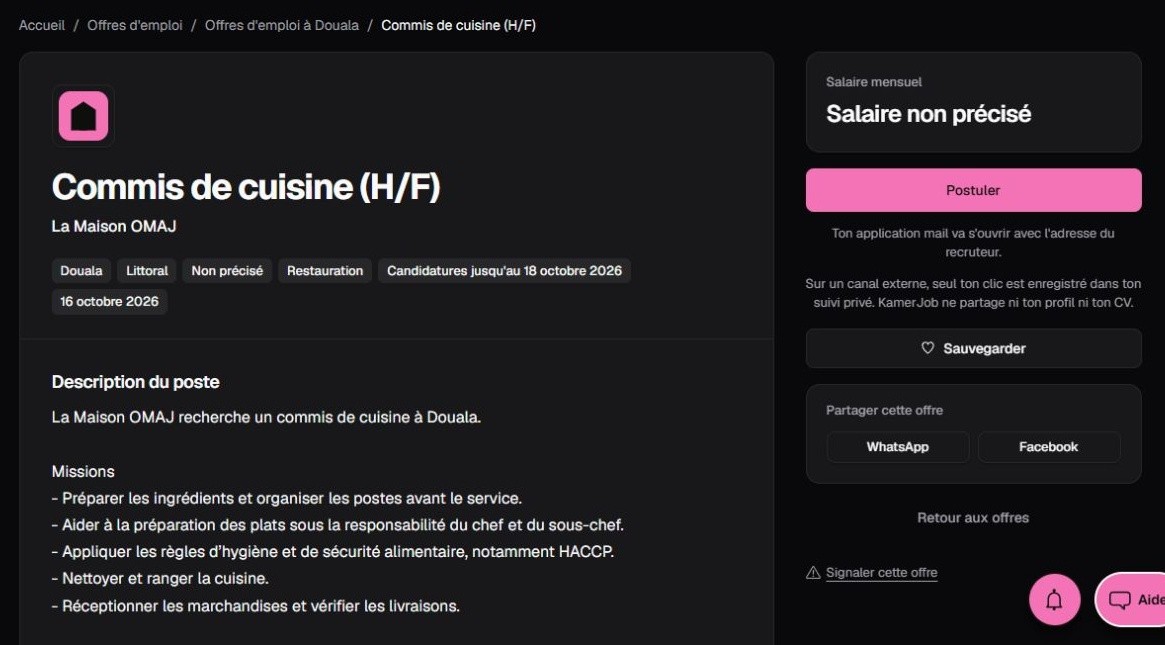
French screenshot from 18 October 2026; the advertised deadline was that same day. An interview preparation example, not a guarantee that recruitment remains open.
Plan your journey, confirm the location and time, and choose clean clothing suitable for an interview. Ask in advance whether a demonstration is planned and what equipment to bring.
2. Introduce your experience in one minute
For a beginner: “My name is [name]. I am looking for a kitchen assistant or commis role. I helped a family business on some Saturdays for three months: preparation under instructions, tidying and cleaning. I am new to restaurant work and want to learn your methods.”
With experience: “I worked for [actual duration] in [establishment type]. I handled [preparations] and organised [tasks]. I can describe a service during which I dealt with [real situation].”
Explain your actual role: helping with preparation is different from running a kitchen. If you show photos, use your own work with the necessary permission and without private customer information.
3. Prepare concrete answers to common questions
“Which dishes can you prepare?”
“I can prepare [dishes you actually know]. In [context], I prepared [known quantity] with [actual assistance or independence]. I still need guidance with [other preparation].”
Choose two or three examples relevant to the establishment’s menu. Do not promise expertise in every cuisine.
“How do you prepare your station before service?”
“I check instructions, expected preparations and available equipment. I organise tasks around the supervisor’s priorities and report missing ingredients or equipment before starting.”
“How do you respond during a busy service?”
“I confirm priorities with the supervisor, flag anything likely to be delayed and ask for help when necessary. I prefer reporting a difficulty rather than letting the team discover it too late.”
“What do you do after a mistake?”
Describe a real mistake, how you reported it and what you changed afterwards. Avoid saying that you never make mistakes.
“Do you know food hygiene procedures?”
Explain procedures you have actually learned and applied. Ask about the establishment’s own procedures and planned training. If you have no HACCP training, say so clearly; an interview does not replace supervised practical learning.

Illustration: August de Richelieu / Pexels. The person pictured does not represent an applicant discussed in this article.
4. Clarify practical trial arrangements
Before starting, ask about the task, time allowed, assessment criteria, supervisor and payment arrangements. Check what equipment and protective items are provided. Do not use unfamiliar machinery without instructions and a demonstration.
Useful question: “For this trial, what preparation do you expect, for how many people and with what equipment? Who will give instructions? What duration and payment are planned?”
If you cannot perform a task, explain that. A demonstration can also reveal how you understand instructions and communicate your limits. Do not let an interview turn into a working day with undefined conditions.
5. Ask about the organisation and terms
- Which dishes, quantities and stations will I be responsible for?
- Who gives instructions and how is service divided between team members?
- Does the role include shopping, stock, washing up or dining-room service?
- What hours, breaks, rest days and extra work are planned?
- What are the pay, payment date and transport or meal expenses?
- What contract and arrangements apply to starting work or any trial?
For late finishes, clarify how you will get home. If accommodation is offered, ask about its conditions, any cost and rest periods. A vacancy does not explain all these details on its own.
6. Finish with a clear next step
Ask when a decision is expected and which documents are still needed. Share a referee’s details with their permission. Verify your contact before sending personal documents.
After-interview message: “Hello [name], thank you for discussing the cook position with me. The duties presented match my experience in [actual skill]. I remain available for [agreed next step]. Could you clarify [remaining point] and the expected decision date? Best regards, [name].”
Before the appointment, practise aloud: a short introduction, three work examples and five questions. This helps you show your skills while checking whether the role matches what you can offer.
Read also: finding your first kitchen job and following up with a recruiter after an interview.
Kamerjob vacancy checked on 18 October 2026. Fictional answers to adapt. Photographs: Dennis Ojenomoh / Pexels (cover) and August de Richelieu / Pexels. Illustrative images.
The Kamerjob team
Comments
Loading comments…