First job: habits that help you earn and keep your employer’s trust

Have you just started your first job? Whether you work in a shop, restaurant, workshop or office, the first few weeks are a time to learn the role and understand how the team works. You will not know everything straight away. You can, however, build habits that make your work more reliable and communication easier.
Arriving on time, asking for clarification, warning someone when a deadline becomes difficult and acknowledging a mistake give your supervisor something dependable to work with. Here are practical tips for your first job in Cameroon, with sample messages and a checklist for your first days.
Keep this in mind: trust grows when your actions match your words. It also depends on clear instructions and a respectful working environment.
1. Prepare for your arrival and keep to agreed hours
Before your first day, confirm your arrival time, the exact address, whom to ask for and any documents or equipment to bring. Plan your journey and allow a realistic margin for transport delays. If the job requires particular clothing, ask about the requirements beforehand.
Punctuality also applies to returning from breaks, promised deliveries and meetings. If something unexpected happens, contact the designated person as soon as it is safe to do so. Give a realistic estimate and update it if the situation changes.
A message to adapt if you are running late: “Hello [name], I have been delayed by [brief reason]. I expect to arrive at [time]. I am letting you know now so you can plan accordingly. I will update you if that estimate changes.”
Ask which channel to use: a call, text message, messaging app or another internal procedure. Telling a colleague does not necessarily inform the right person. For an absence, find out which steps and supporting documents are expected.
On Kamerjob: review the vacancy before your first day
If you found the job on Kamerjob, return to the advert and note the location, duties and contract type. Use these details to prepare questions, then confirm the actual arrangements agreed with your employer.
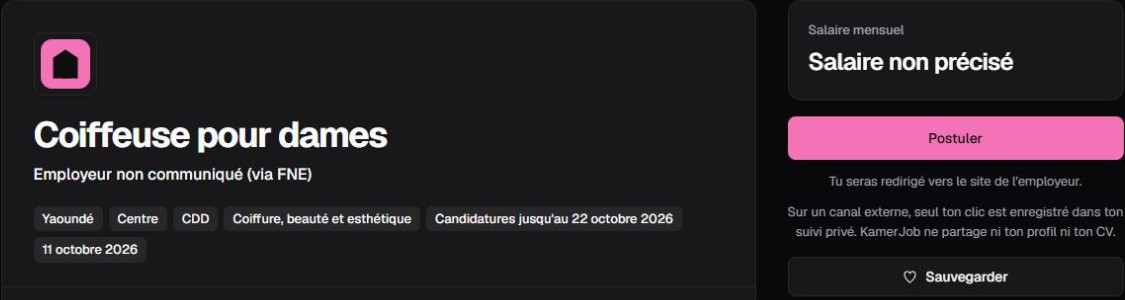
Exercise: identify the location and contract in this example, then list what you still need to ask: your work address, hours, direct supervisor and priority tasks. An advert does not replace the documents and discussions that clarify your employment arrangements.
Kamerjob screenshot captured on 17 October 2026, used as a reading example. It does not mean the vacancy is still open. For help understanding contract labels, see our guide to contract types.
2. Understand the instructions before you begin
At first, take notes on tasks, important steps and people who can help. A small notebook is enough. For each new request, establish the expected result, deadline and how to check your work.
You can simply repeat the instruction in your own words: “If I have understood correctly, I need to prepare [result] by [time or date], then ask you to check it. Is that right?” This helps you catch a misunderstanding before it becomes a problem.
Fictional example: in a shop, you are asked to prepare an order. Before packing it, check the product reference, quantity and customer’s name. If two products look similar, ask for confirmation. You will become more independent as you learn the product references.
If two people give you urgent tasks at the same time, explain what you are already doing and ask which takes priority. Avoid promising two incompatible deadlines.
To clarify priorities: “I am currently finishing [task], which is due by [time]. You have also asked me to do [new task]. Which should I handle first?”
For an unfamiliar machine, product or procedure, ask for a demonstration and safety instructions. Report a hazard rather than improvising an operation you do not know how to carry out.
3. Give useful updates, especially when a problem arises
Your supervisor cannot always see how your work is progressing. Agree when to give updates: after an important step, at a particular time or when you encounter a problem. A useful update answers three questions: what is finished, what is blocking progress and what help do you need?
If you realise you will miss a deadline, say so before it passes. Explain the situation and suggest a realistic next step, rather than guessing a new completion time.
To report a problem: “I have completed [finished part]. I need [information or equipment] to continue. We may miss the planned deadline. Could you confirm [decision needed]? I can then give you a more accurate estimate.”
Report mistakes with facts
If you make a mistake, avoid hiding it or immediately blaming someone else. Explain what you have noticed, the possible consequences and what you have already done to prevent things getting worse. Ask what to do before attempting a risky correction.
Fictional example: you notice a difference between a recorded quantity and the amount actually received. Count again, keep the available documents and report the discrepancy. Do not change a record simply to make the difference disappear.
After the correction, choose a simple way to prevent a repeat: a second check, a checklist or confirmation before approval. The aim is to improve the next time.
4. Take care of equipment and working relationships
Put tools away, clean your workspace as instructed and report faults. If you use a till, work phone or keys, ask about handover and return procedures. Do not take equipment or documents away without permission.
Discretion matters too. Handle customer contact details, internal documents and information about colleagues according to company rules. Before transferring a file to your personal phone, taking a photo or posting a workplace video, check what is allowed.

Listening, clarifying and sharing useful information support teamwork. Illustrative photo: Christina Morillo / Pexels.
Greet people, listen without interrupting and ask questions directly to the person concerned. If you disagree, return to the facts: the task, deadline, instruction or expected result. Avoid passing on rumours about colleagues or customers.
Ask about the team’s rules for personal phones. If an emergency requires a call, let someone know and step aside where possible and compatible with your duties.
5. Ask for feedback and make steady progress
After a few days, ask your supervisor for a short conversation: “What am I doing well? What should I improve first?” Then choose one specific improvement rather than several vague goals.
Fictional example: you are told that orders are prepared correctly, but you sometimes forget to say when they are ready. Your goal for the week could be to send the agreed confirmation whenever an order is complete.
Keep a simple record of what you have learnt: a procedure, a tool or a task you can now do with less help. These notes will help you prepare for feedback conversations and later update your CV with accurate achievements.
Your first-week checklist
- On arrival: confirm your hours, direct supervisor and the channel to use when notifying them.
- For each new task: note the expected result, deadline and necessary checks.
- If you are stuck: inform the right person, explain the facts and ask a specific question.
- Before leaving: tidy up, pass on useful information and check priorities for your next working day.
- At the end of the week: ask for feedback and choose one area to improve.
Trust works both ways. Ask for clear expectations and report difficulties you cannot resolve alone. Being professional also means saying when you do not understand an instruction, a deadline seems unrealistic or a task presents a risk.
Choose one habit for your next working day: plan your journey, clarify an instruction or give a clear progress update. Practised consistently, that habit will help your team understand how your work is going. If you are still looking for your first opportunity, browse Kamerjob’s vacancies and our guide to finding work without qualifications in Cameroon.
The situations and messages in this guide are examples to adapt to your role and your employer’s procedures.
Photo credits: Edmond Dantès / Pexels and Christina Morillo / Pexels. Screenshot: Kamerjob. The people pictured illustrate teamwork and are not presented as Kamerjob employees.
Cover photograph: Monstera Production / Pexels. Illustrative image.
The Kamerjob team
Comments
Loading comments…