Truck and semi-trailer driving: how to showcase your experience

Have you driven trucks or tractor units with semi-trailers? To convince a recruiter, specify the vehicles, routes and your role in following transport operations. “Experienced driver” alone does not explain your background.
Here is how to present that experience on a CV and in an interview in Cameroon. The templates are fictional and must be adapted to what you have actually done.
1. Name the vehicles and your level of independence
Distinguish a rigid truck from a tractor unit with a semi-trailer. List configurations and equipment you have actually used, such as flatbeds, tippers or container transport. Experience with one does not automatically establish competence with another, especially tankers or specialised transport.
Put your licence categories and validity near the CV title. Check suitability for the vehicle and vacancy requirements. Explain whether you drove independently, with a second driver or under supervision; accompanied training should not be presented as full independence.
2. Match your application to advertised requirements
The KM International advert for twenty truck drivers in Kribi mentioned a category CE licence, delivery notes, a journey log and reporting faults.
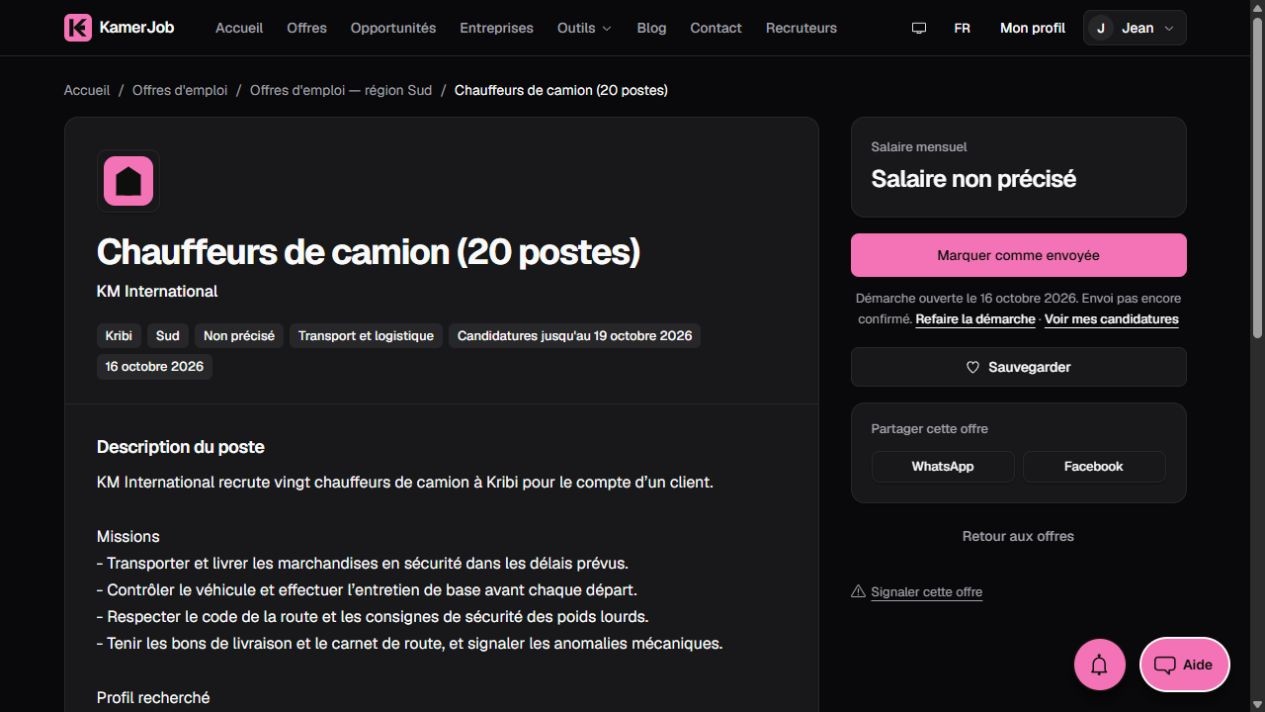
Screenshot taken on 18 October 2026, in French. The displayed deadline was 19 October 2026; check the vacancy’s current availability.
Another advert for drivers on the Chad–CAR corridors emphasised long-distance experience, transit procedures, border operations and safety. It illustrates requirements rather than being presented as an open vacancy.
Select three responsibilities from each advert and prepare evidence for each. Do not claim knowledge of a corridor simply because you recognise its name.
3. Describe routes and goods precisely
List areas and routes actually covered, journey frequency and the setting: regional distribution, interurban freight, port activity or international transport. Describe goods in general terms without disclosing confidential customer information.
“[Vehicle type] driver — [business or setting], [dates]. Transported [goods] on [routes actually covered]. Drove [independently/with another driver], maintained assigned documents and communicated with operations staff.”
Only add distances or volumes when reliable and explainable. Distinguish following up formalities with a forwarding agent from personally completing those formalities. Occasional work over several years does not automatically equal that many years of full-time employment.
4. Show the work around driving
- Preparation: checks and reporting under employer procedures.
- Paperwork: journey logs, delivery notes and returning supporting documents.
- Coordination: communication with operations, loading sites and recipients.
- Traceability: recording waiting periods, refusals, discrepancies or incidents.
- Organisation: following schedules within safety requirements and applicable rules.
Describe your exact role in loading, load securing or specialist operations. Do not turn supervised participation into a qualification. This article helps present experience; it does not replace technical training or the operator’s procedures.
5. Prepare two interview situations
Fictional example: delayed loading.
“The load was not ready at the scheduled time. I informed operations, recorded the waiting period under the procedure and requested an updated instruction. I communicated the revised timing without trying to recover the delay through risky driving.”
Fictional example: a fault observed before departure.
“During the required checks, I noticed [specific observation]. I informed the supervisor and waited for the appropriate decision before the assignment. I described what I observed without improvising repairs beyond my skills.”
Replace these templates with actual experiences. Explain the observed result and who made the decision. Avoid promises such as “I always deliver whatever happens”: they do not demonstrate sound handling of constraints.
6. Provide evidence and clarify the future role
An authorised reference, employment certificate or anonymised report can support your account. Ask permission before sharing company documents, contact details or site photographs. Do not expose customers’ personal documents, confidential loading information or identity document numbers.
Before accepting, ask about assigned vehicles, routes, goods, training, rest arrangements, mission expenses and each person’s responsibilities. If an assessment is proposed, clarify the equipment, supervision, duration and vehicle use and insurance arrangements.
Prepare your driver CV and interview, then browse Kamerjob vacancies. Clearly described experience helps a recruiter understand your existing skills and the adaptations needed for the role.
Cover: Muhammad-Taha Ibrahim / Pexels. Illustrative stock photo; the person pictured is not associated with the adverts or scenarios.
The Kamerjob team
Comments
Loading comments…