Daily pay on a construction site: how to clarify your earnings

“The work is paid by the day.” Before starting on a site, clarify the amount, hours, tasks and payment date. A daily rate does not automatically mean payment every evening.
Here are questions and messages to adapt. Calculations below are fictional: they are neither recommended rates nor a legal minimum in Cameroon.
1. Clarify the amount and what it covers
Ask whether the amount is per person or per team, which tasks are included and what will actually be paid. Separate earnings from transport reimbursement, meals and other benefits. Ask for an explanation of any proposed deduction.
The Kamerjob masons and labourer advert in Logbessou advertised FCFA 3,500 per day for the labourer without specifying hours or duration. That figure belonged to the advert; it does not establish an occupational rate.
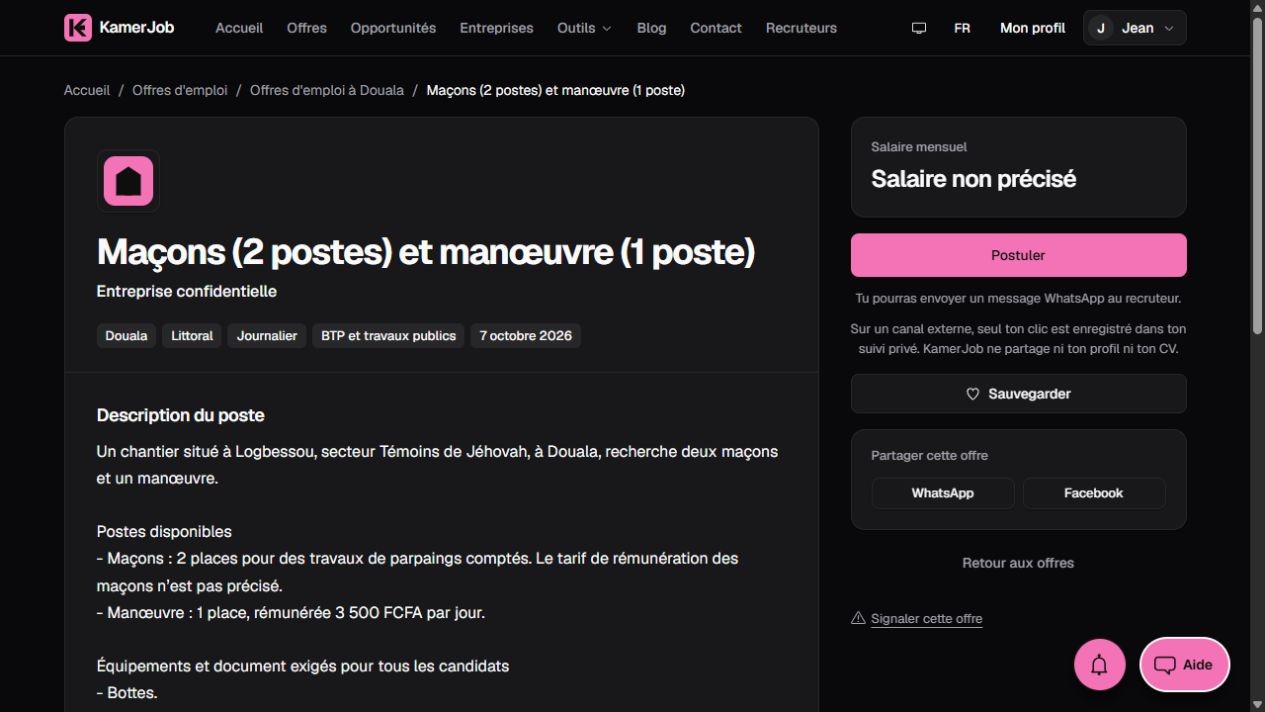
Screenshot taken on 18 October 2026, in French. An example of terms to clarify; confirm current availability.
“Is the amount for one person and which tasks? Which expenses or benefits are included? Are deductions proposed, and for what reason?”
2. Define the expected working day
Ask about arrival, starting and finishing times, breaks and expected assignment length. Clarify how hours beyond the schedule are recorded and treated under applicable rules.
Also ask what happens if materials arrive late, rain interrupts work or the supervisor cancels before you arrive. Do not automatically count half a day as half the rate without checking the terms and applicable rights.
These situations need specific answers; do not invent a rule based on practices heard about at another site.
3. Ask when and how payment happens
Payment may be proposed at the end of the day, week or another agreed date. Confirm the date, method, responsible person and supporting record.
“The rate is daily, but is payment made each evening or on another date? Who pays, and how are days worked validated?”
For mobile payments, check the receiving number and ask how any fees are handled. Never give the recruiter your payment or verification codes. A message promising a transfer is not confirmation that funds were received.
4. Keep a simple record
Record the date, site, hours, tasks, agreed amount, advances and payments received. Review it regularly with the supervisor and keep confirmations and receipts.
Fictional example: four confirmed days at FCFA 4,000 total FCFA 16,000. If FCFA 5,000 was received as an advance against those earnings, the balance is FCFA 11,000, with no other adjustments. Money advanced to buy materials should be tracked separately; it is not automatically a wage advance.
“For our records: days [dates], agreed total [amount], wage advance [amount], payment received [amount], balance [amount]. Could you confirm?”
This summary helps reconcile figures; it does not replace required documents or resolve a disagreement about applicable rights.
5. Confirm terms before starting
A short message can preserve the discussion:
“I confirm availability for the site in [place] from [date]. We discussed [tasks], from [time] to [time], for [amount] per day, payable [date or frequency]. Expenses and equipment: [details]. Could you confirm these terms and arrangements if work stops?”
Do not describe a point as agreed until it is. Clarify who employs you and who gives instructions, especially when an intermediary assembles a team.
For minimum pay, classification, deductions or working-hour rules, check current legislation and any applicable collective agreement with the labour inspectorate. The Cameroon Labour Code listed by the ILO is a starting point to supplement for your situation. Negotiation does not replace employer obligations.
6. Request reconciliation if payment is late or different
Contact the responsible person with dates and amounts, without accusations or threats. Ask for an explanation and a specific payment date.
“Hello, the payment expected on [date] has not arrived. My records show [days], [total], [received] and [balance]. Could we check this together and confirm the payment date? Thank you.”
Keep communications. Do not sign a document stating you received money that was not paid. If disagreement continues, seek appropriate assistance from the labour inspectorate or a qualified professional with your available records.
Before another assignment, read our guide to applying through WhatsApp and browse Kamerjob labourer vacancies. Clear pay arrangements start with precise questions and regular records.
Cover: Harrun Muhammad / Pexels, photographed in Abuja, Nigeria. Illustrative image, unrelated to the fictional scenarios or cited advert.
The Kamerjob team
Comments
Loading comments…