Nanny or housekeeper: questions to ask before accepting a job

A family offers you a childcare job. A residence needs someone to clean its rooms. Before saying “I can start tomorrow”, take time to understand the duties, hours and pay. Asking questions shows professionalism and helps everyone know what to expect.
This guide is for nannies, housekeepers and people combining both roles in Cameroon, including those who learned their skills through informal work. The sample conversations are fictional; the two illustrated vacancies are real Kamerjob listings.
1. What exactly will my duties be?
“Looking after the home” can mean very different things. Ask for a list: childcare, cooking, laundry, ironing, shopping, cleaning or school runs. How many people live there? How many rooms need cleaning? Will someone else share the work?
For childcare, ask about the number and ages of the children, their routines, authorised pickup arrangements and emergency contacts. Find out what instructions the parents will provide. Be honest about duties you are not trained to perform.
Example: “While I am watching the baby, am I also expected to cook and iron? If several needs arise at once, what takes priority and who can help me?”
 Illustrative stock photo: Anna Shvets, Pexels. The people pictured are not presented as job applicants or employees.
2. Kamerjob example: a combined nanny and housekeeping role
The “Nounou Ménagère Non Résidente” listing in Douala, published on 6 October 2026, combines household duties with support for the family. It advertises 7:30 a.m.–6 p.m. Monday to Friday, a half-day on Saturday and some weekends off depending on the employer’s availability. The advertised pay is CFA 50,000 per month.
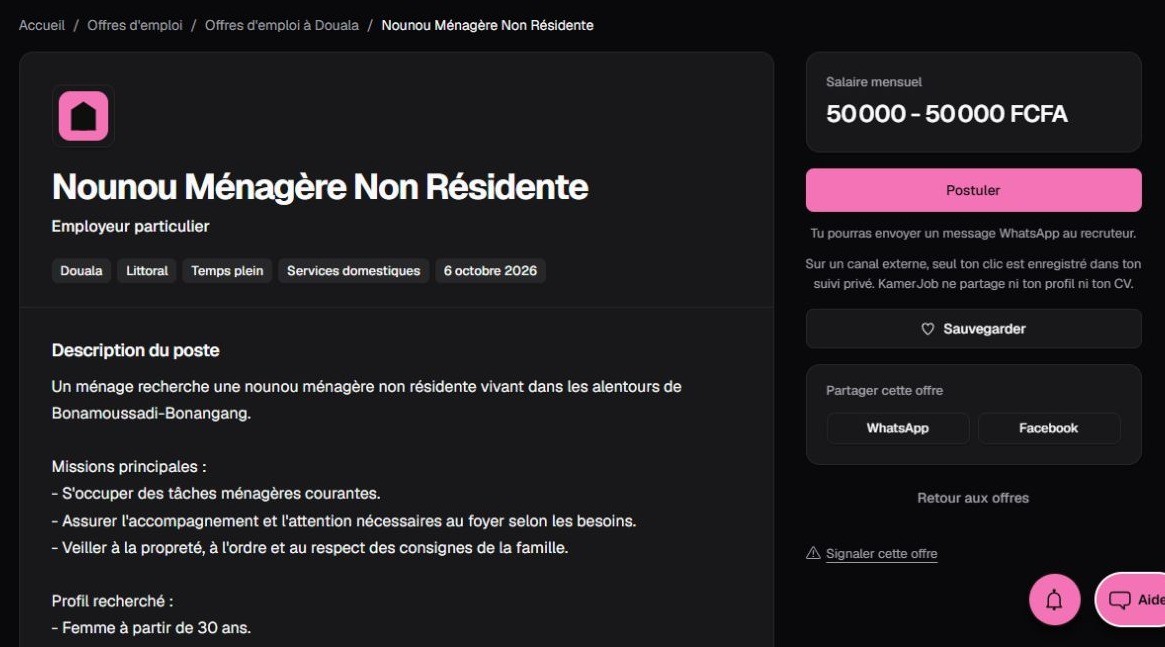 Kamerjob vacancy screenshot viewed on 18 October 2026. Listings can change or expire; check availability before applying.
Useful questions: What time does the Saturday half-day end? Which rest days are planned and when will they be confirmed? What happens if the parents return after 6 p.m.? Who watches the children during household tasks? Is transport provided or paid for by you?
The pay quoted is only the amount advertised for this vacancy. It is neither a salary benchmark nor an endorsement of the advertised terms.
3. What are the working hours, breaks and on-site conditions?
- What time does each day start and finish? Which days will I work?
- How are breaks, meals and rest days organised?
- How will extra hours, evenings or additional weekends be agreed and paid?
- Who provides the materials, cleaning products and suitable equipment?
- Who should I contact for instructions or to report a problem?
For a live-in role, ask to see the sleeping space and clarify privacy, bathroom access, meals and the periods when you are free to use your time as you choose. Living on site does not, by itself, explain when you are expected to work: ask for a clear schedule.
Example: “You are looking for a live-in employee. Could you explain the working hours, planned rest periods and what is expected if a child wakes up at night?”
4. How much will I earn, when will I be paid and by whom?
Ask for the agreed amount, payment frequency, payment date and method. Clarify what is included or separate: meals, transport, accommodation if applicable, household purchases and shopping expenses. If an agency is involved, establish who employs you, who gives instructions and who pays your wages.
Also ask about the proposed contract, start date and any trial arrangement: its length, duties, hours and payment. Avoid starting on an unclear “come and try, we will discuss it later” basis. For legal questions, seek information from the relevant services rather than treating a vacancy as a statement of the rules.
5. Kamerjob example: detailed duties, with questions still to ask
The “Dame de ménage” listing for a furnished residence in Omnisports, Yaoundé, published on 13 October 2026, mentions rooms, floors, dishes, laundry, ironing, bathrooms and shared areas. It specifies Monday to Saturday, 7:30 a.m.–3:30 p.m. When we viewed it, the salary and contract type were not specified.
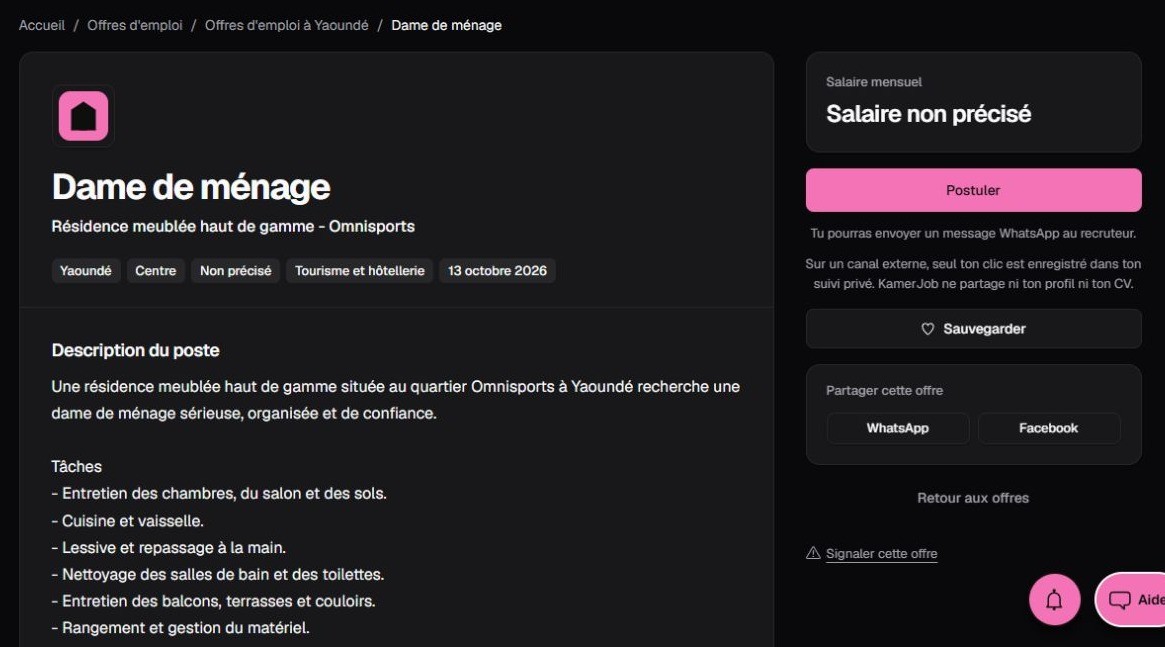 Screenshot viewed on 18 October 2026. This example helps you prepare questions; it does not guarantee that recruitment is still open.
Sample message: “Hello, I am interested in your housekeeping vacancy in Omnisports. What salary and contract do you offer? How many rooms need cleaning each day? Is laundry handled on site, and what equipment is available? How are breaks and any schedule changes organised?”
6. How can I check the arrangements and keep a record?
Before an appointment, verify who you are speaking to, the organisation’s name where relevant and the workplace. Tell someone you trust about the appointment. Never share payment or login codes. Do not leave original identity documents as a deposit to secure a job. If someone asks for money or pressures you to accept without explaining the role, pause and check.
After the interview, send a summary. It can reveal misunderstandings and help prepare employment documents; it does not replace the formalities appropriate to your situation.
“Hello, thank you for our conversation. To confirm: my duties will be [tasks], at [location], on [days], from [start] to [finish], with [breaks and rest periods]. The agreed salary is CFA [amount], paid on [date] by [method]. [Transport/meals/accommodation]: [terms]. The planned start date is [date], and any trial period will follow [terms]. Could you confirm these points and send me the proposed contract before I commit?”
Before saying yes: five things to check
- I know who employs me, where I will work and who I report to.
- The duties and priorities are clear enough.
- Hours, breaks, rest periods and extra work have been clarified.
- Pay, payment dates and expenses have been explained.
- I understand the start arrangements, any trial period and the proposed contract.
If something remains unclear, you can say: “I am interested in the role, but I need to clarify this point before confirming my availability.” Your experience deserves a professional presentation, and your decision deserves clear information.
Read also: presenting your experience from informal work and recognising a fake job offer.
Stock photographs: Monstera Production — cover and Anna Shvets — woman holding a baby, via Pexels. Illustrative images.
The Kamerjob team
Comments
Loading comments…