Labourer without formal qualifications: how to present your experience

Have you worked on building sites without formal qualifications or a written contract? You can still describe tasks actually performed, periods worked and how you followed instructions. Help the recruiter understand what you can do and the supervision you need.
The templates below are fictional: replace the brackets and remove any task you have not performed.
1. List your site experience
For each experience, record the site type, town or neighbourhood, dates and frequency. Explain whether it involved a few days, regular work or occasional assignments. A few days spread across a year do not equal a full year of employment.
For example: “Occasional support on a house-building site in [area], between [month] and [month], approximately [verifiable number] days.” Mark approximate dates honestly rather than inventing precision.
You do not need to publish a private client’s name: “site for a private client” is sufficient. Distinguish paid work, family help and apprenticeship.
2. Describe duties rather than only a title
“I worked in construction” does not explain your contribution. Name specific activities: tidying, cleaning a workstation, assisting a mason or moving materials with the provided equipment and instructions.
“Labourer — private building site, [town], [period]. Supported the team with [actual tasks]. Stored equipment in designated places, cleaned the work area and reported requirements to the supervisor. Worked under instructions from [role].”
If you assisted with plastering, tiling or steel fixing, specify your contribution. Helping a tradesperson does not establish independent mastery of the trade. Do not claim machinery operation, work at height or specialist tasks without appropriate qualifications.
3. Match your background to the advert
The masons and labourer advert in Logbessou distinguished roles and listed equipment and a supporting document without specifying a minimum diploma. This does not mean every employer has the same requirements: read each advert.
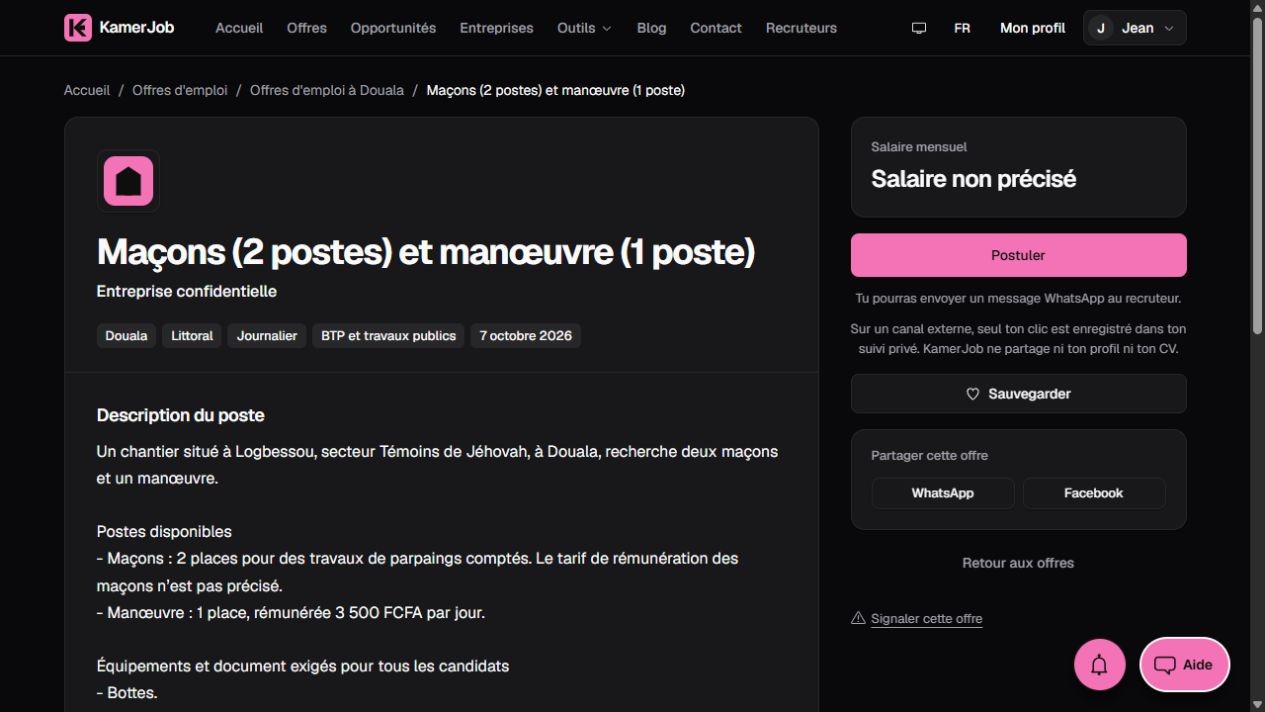
Screenshot taken on 18 October 2026, in French. A learning example; confirm availability before applying.
The older tiling assistant or apprentice advert in Yaoundé emphasised willingness to learn and proximity to the location. It was closed when checked on 18 October 2026 and is used only as an example.
Identify requested duties and conditions, then select matching experience. Motivation alone does not replace an explicitly required qualification.
4. Demonstrate reliability with a real situation
Prepare an example of punctuality, understanding instructions or reporting a problem. Explain the context, your action and the actual result.
“The supervisor asked me to prepare a storage area. Because the location was unclear, I requested confirmation before moving equipment. The team then found the items in the agreed place.”
This example is fictional. Use your own situation without invented figures or promises that you can do everything. Asking for clarification about an unfamiliar task can demonstrate a careful approach.
5. Prepare a short CV or WhatsApp message
Your introduction can fit on one page: name, reachable number, town or area, target role, experience, skills and availability. If describing schooling, give accurate information; do not invent a qualification to fill a section.
“Hello, my name is [name] and I live in [area]. I am looking for labourer work. I helped with [setting], carrying out [two tasks]. I am available from [date]. Is the vacancy still available? Could you clarify the duties, location and conditions? Thank you.”
The Kamerjob CV builder can help format your experience. If you need writing support, ask a trusted person to review the document and check every detail before sending it.
6. Use evidence with permission
A former supervisor’s reference can support your application: obtain consent before sharing their number. An authorised statement or photo may also explain your work. State your contribution to any pictured project; a finished building photograph does not prove you completed the entire structure.
Never present a stock photograph as your own work. Do not publish private contact details, identity documents or photographs of people without permission.
Before starting, clarify tasks, payment, duration, hours, equipment and supervision. Ask for instructions and suitable training for unfamiliar tasks. Experience can be valuable without formal qualifications when described accurately and matched to appropriate work.
Browse labourer vacancies and read our guide to starting your search.
Cover: Mukhtar Shuaib Mukhtar / Pexels, photographed in Nigeria. Illustrative photo, unrelated to fictional candidates or cited recruiters.
The Kamerjob team
Comments
Loading comments…