Practical kitchen trial: how to prepare and which conditions to clarify

A restaurant invites you to “come for a trial”. Before travelling, ask what this means: a short observed preparation task, participation in a service or several working days? The expected time, duties and conditions should be clear.
A practical trial may help an employer observe your organisation, understanding of instructions and skills. Prepare to show your actual level without promising abilities you do not have. The scenarios and messages in this guide are fictional and should be adapted.
1. Clarify the arrangement before confirming
Ask for answers to these questions, preferably in writing:
- The location, date and expected start and finish times.
- The preparation task, quantities and whether you will join a real service.
- The supervisor and assessment criteria.
- Equipment, ingredients, clothing and protective items provided or required.
- The planned payment, payment method and date, and any expenses.
- The next step: feedback, a decision and any proposed start date.
Before-trial message: “Hello, thank you for the invitation. To prepare for the trial on [date], could you clarify the task, duration, supervision, equipment to bring and payment arrangements? Is this an exercise or participation in service?”
If an employment contract refers to a probationary period, ask for the corresponding documents and terms too. Do not infer the arrangement solely from the word “trial”.
2. Prepare for the actual role
Read the vacancy again. A commis may support preparation and organisation; an independent cook may face different expectations. Ask which skill will be assessed rather than preparing a difficult recipe at random.
For example, the Commis de cuisine listing at La Maison OMAJ in Douala mentions ingredient preparation, assisting the chef and cleaning. It helps identify tasks to discuss with a recruiter, but does not itself describe a practical trial.
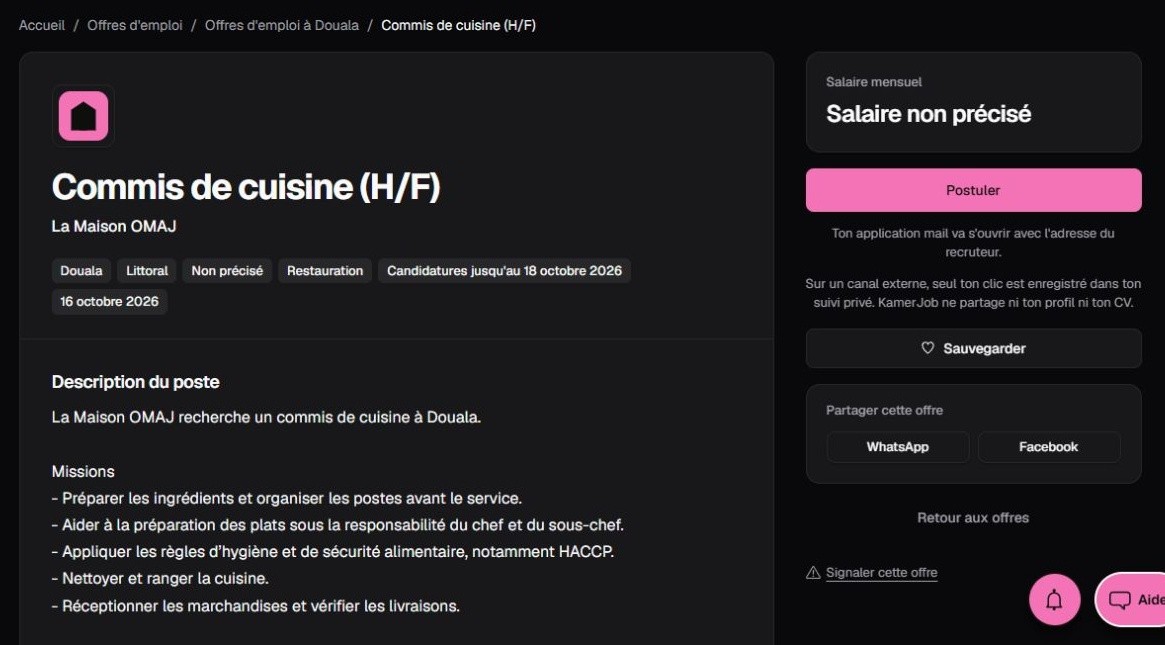
French screenshot from 18 October 2026; the advertised deadline was that same day. A duties-reading example, without a guarantee that recruitment remains open or this employer organises trials.
Prepare a short introduction, plan your route and notify the employer if delayed. Do not buy expensive equipment or ingredients before clarifying what is required and who covers the cost.
3. Repeat the instructions back at the start
Before handling equipment, identify your supervisor, assigned space and the establishment’s procedures. Clarify the preparation, portions, expected result and available time.
Example: “To confirm my understanding, I will prepare [task] for [quantity] by [time], using your instructions. You want to assess [criteria]. Who should I tell about missing supplies or difficulties?”
Explain what you are unfamiliar with. Ask for a demonstration of a new machine or procedure. A question before starting is more useful than an assumption that disrupts the work.
4. Make your work understandable during the exercise
Organise tasks according to instructions and keep the supervisor informed about difficulties. Follow the hygiene and safety procedures taught on site; do not claim training you have not completed.
- An ingredient is missing: report it and obtain approval before changing the preparation.
- The deadline seems unrealistic: explain your progress and ask which task takes priority.
- You make a mistake: promptly explain what happened and ask how to proceed.
- A task exceeds your skills: say so before doing it and request support.
Sample wording: “I have finished [stage]. [Stage] remains, but [difficulty]. Would you like me to continue this way or prioritise [other task]?”
Do not photograph internal recipes, customers or work areas without permission.
5. If conditions change, agree on the new arrangement
An exercise advertised for an hour may become a request to stay until closing. Before extending it, clarify the new duration, duties and payment. You can request time to consider the proposal if those details remain unclear.
“We planned to finish at [time]. You are now proposing that I join service until [time]. What conditions would apply to this extension? I need to understand them before confirming.”
You do not need to hand over payment or login codes to secure a job. Verify requests for money and do not leave original identity documents as a deposit.
6. Finish with feedback and a next step
Ask what went well, what needs improvement and when a decision will be communicated. Confirm the agreed payment arrangements and keep the conversation and your actual hours.
After-trial message: “Hello [name], thank you for today’s exercise from [time] to [time] on [tasks]. What feedback can you give me? Could you confirm the next step and the agreed payment of [amount], due on [date]? Best regards, [name].”
Before leaving: tasks are completed or handed over, the supervisor knows your progress, agreed conditions have been summarised and you know how to obtain a response.
Continue preparing with our guides to a cook job interview and finding your first kitchen job.
Fictional examples; Kamerjob listing checked on 18 October 2026. Cover photograph: Andres Ayrton / Pexels, an illustrative image unrelated to the employer discussed.
The Kamerjob team
Comments
Loading comments…