Software developer: how to demonstrate your AI integration skills

Added an AI feature to an application? To convince an employer, show more than one successful response on screen. Explain the problem solved, your software contribution, tests and what happens when the model is wrong or unavailable.
Integrating an existing model does not mean you trained it. Describe your role precisely: API connection, document retrieval, data validation, interface, deployment or monitoring. The projects below are fictional examples to adapt.
1. Choose a specific professional need
Start with a useful, limited task: drafting an answer from public documentation, extracting fields from a fictional document or suggesting categories for support requests. Define expected behaviour and what stays under human control.
Example: “An assistant proposes an answer from an authorised catalogue. Users can inspect references and approve the answer before sending. If documents are insufficient, the application says so.”
Compare with conventional search or simple rules. Explain why a model helps and where it mainly adds cost or uncertainty.
2. Show what you built
Present the flow: user input, access checks, data preparation, model call, result validation and display. A simple diagram and README make the application understandable without reading all its code.
- Which components did you personally develop?
- Which model or service and configuration do you use?
- What data leaves the application and why?
- Which limits, errors and outages do you handle?
For structured responses, check format and business rules in software. Well-formed output may still be incorrect, so content validation remains necessary. Do not expose secret keys in the browser, public repository or video.
3. Prepare reproducible evaluation
Build documented cases: normal, ambiguous and out-of-scope requests, incomplete documents and content attempting to redirect instructions. Separate development cases from those reserved for final evaluation.
Define criteria before presenting results: field accuracy, genuinely relevant references, abstention when information is missing and quality under an explicit rubric. A displayed reference alone does not establish correctness.
Template to complete with measurements: “Version tested: [version]. Cases evaluated: [number]. Criteria: [rubric]. Results: [verified values]. Observed failures: [examples]. Next improvement: [action].”
Measure response time and cost under stated conditions: model, input size, test volume and date. Do not promise unmeasured savings or quality.
4. Demonstrate failure handling and permissions
Show timeout, quota, invalid-output and service-outage behaviour. Set request and spending limits; avoid unlimited retries. Where operations can change data, prevent duplicate actions.
Retrieved documents may contain malicious instructions. OWASP describes prompt-injection risks. Retrieval-augmented generation, or RAG, does not eliminate them. Enforce authorisation in code, limit access and require approval before sensitive actions execute.
A demonstration can show denied access to an unauthorised document or a fallback message. Explain remaining limits rather than claiming complete security. Use authorised public or fictional data and avoid sensitive information in logs.
5. Connect your project to Kamerjob vacancies
A historical Vantum Backend Engineer – AI Systems vacancy mentioned APIs, model integration, data pipelines, latency, cost and reliability. Its displayed deadline was 30 June 2026: it is a historical example, not an available vacancy.
The Wynd Labs Machine Learning Engineer advert, identified on Kamerjob on 18 October 2026, lists Python and LLMs with a displayed 21 October deadline. Confirm status and full requirements with the employer; it is not necessarily the same role as a developer integrating an API.
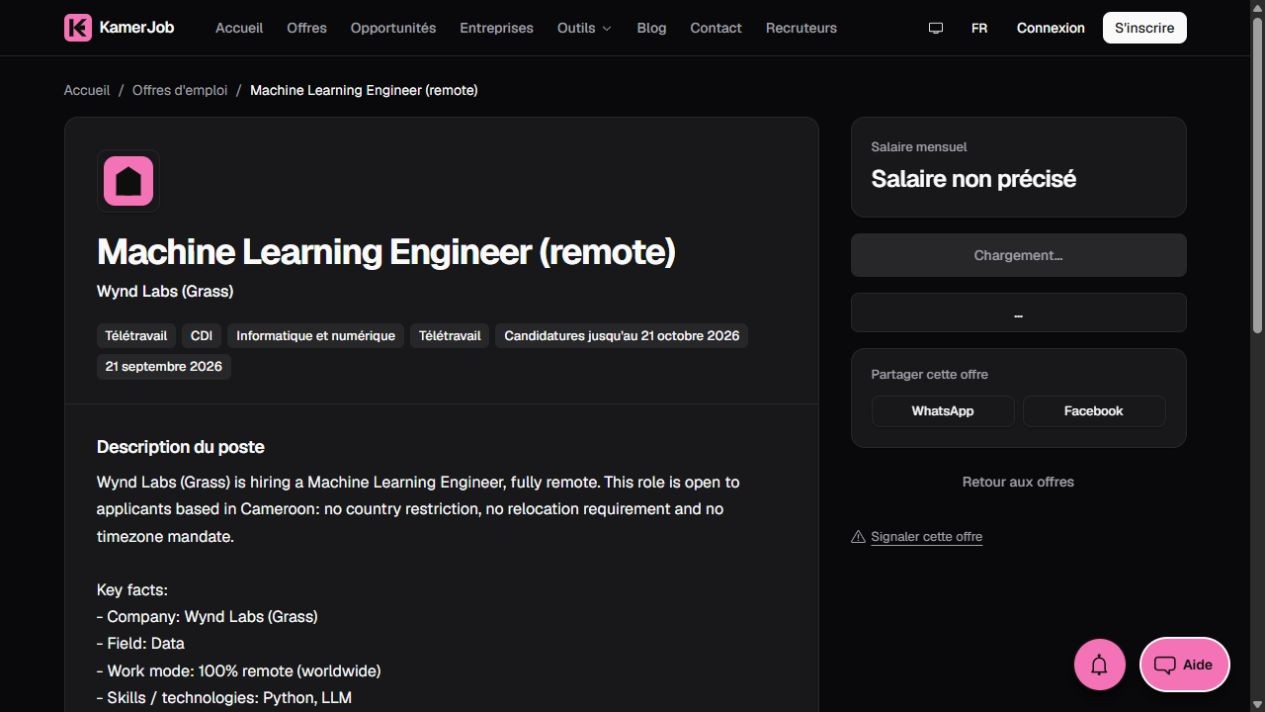
Screenshot dated 18 October 2026. Compare your level with each role’s actual responsibilities.
6. Make your work easy to review
Provide an authorised repository, README, run instructions, relevant tests and a short demonstration. Distinguish prototypes, exercises and applications actually used. Credit other team members’ contributions.
CV example: “Personal project — integrated a document assistant into [application]. Built [components], access checks and tests on [cases]. Measured results: [values]. Limits: [known issues]. Repository: [link].”
In interviews, explain a difficult decision and a failure you corrected. If you used AI coding assistance, follow assessment rules and be able to explain and verify delivered code.
Browse Kamerjob vacancies and tailor evidence to each role. Also read our Machine Learning Engineer application guide.
Cover: Naboth Otieno / Pexels. Illustrative photograph unrelated to the employers mentioned. Screenshot: Kamerjob.
The Kamerjob team
Comments
Loading comments…