Driver CV: how to present your driving licence and experience

A recruiter should quickly find your licence, the vehicles you have driven and the duties you can perform. A driver CV therefore needs specifics: “driving” alone does not explain delivery experience, passenger transport or truck driving.
Here is how to prepare a CV for vacancies in Cameroon, with templates to personalise and two screenshots of Kamerjob adverts. The candidate examples are fictional; the cited requirements come from the linked adverts.
1. Put the target role and licence near the top
After your name, town and contact details, choose a title suited to the application: “Personal driver”, “Delivery driver” or “Truck driver”. List the licence categories you actually hold and their validity after checking your document.
“[First name Last name] — [Town]
Phone: [number] · Email: [address]
Delivery driver — Valid category [category] licence
Available from: [date] · Willing to travel to: [areas you genuinely accept]”
You can state when you obtained your licence if relevant. Distinguish that from professional experience: holding a licence for five years does not mean you have worked as a driver for five years. If renewal is pending, explain the exact situation rather than claiming validity without checking.
Do not display your full licence number or an identity card copy in a publicly distributed CV. Send requested supporting documents through a verified channel. Check the category required for the actual role and vehicle; a job title alone does not establish the qualifications needed.
2. Read the requirements before choosing your experience
Truck driving example: KM International, Kribi
The advert for twenty truck drivers specified a valid category CE licence, a current national identity card, delivery paperwork and a journey log. For this type of application, highlight the vehicles, routes and record-keeping tasks you genuinely know.
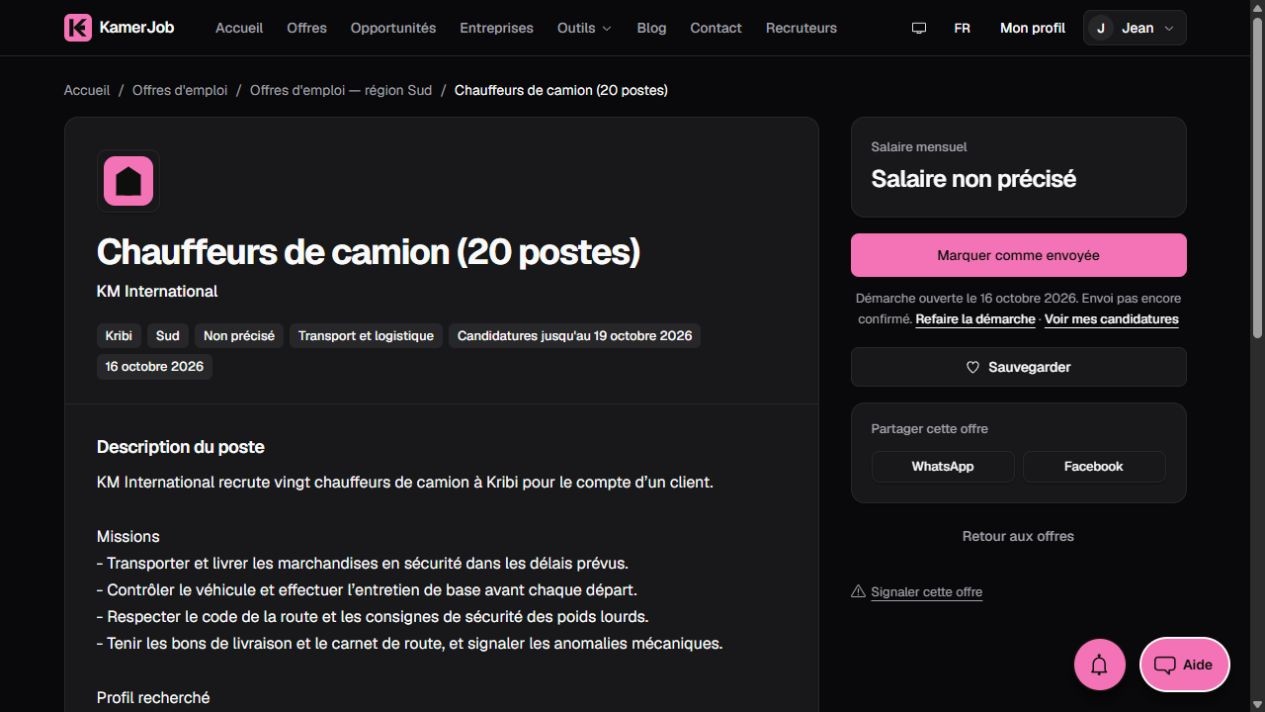
Kamerjob screenshot taken on 18 October 2026, in French. The displayed deadline was 19 October 2026. Check the current advert; this screenshot illustrates how to read requirements.
Delivery example: Tim Hills Cameroon, Douala
The advert for two delivery drivers specified a category C licence, at least two years’ experience and knowledge of Douala and its surroundings. It also required document checks and collecting signatures. Simply writing “good driver” would leave those skills invisible.
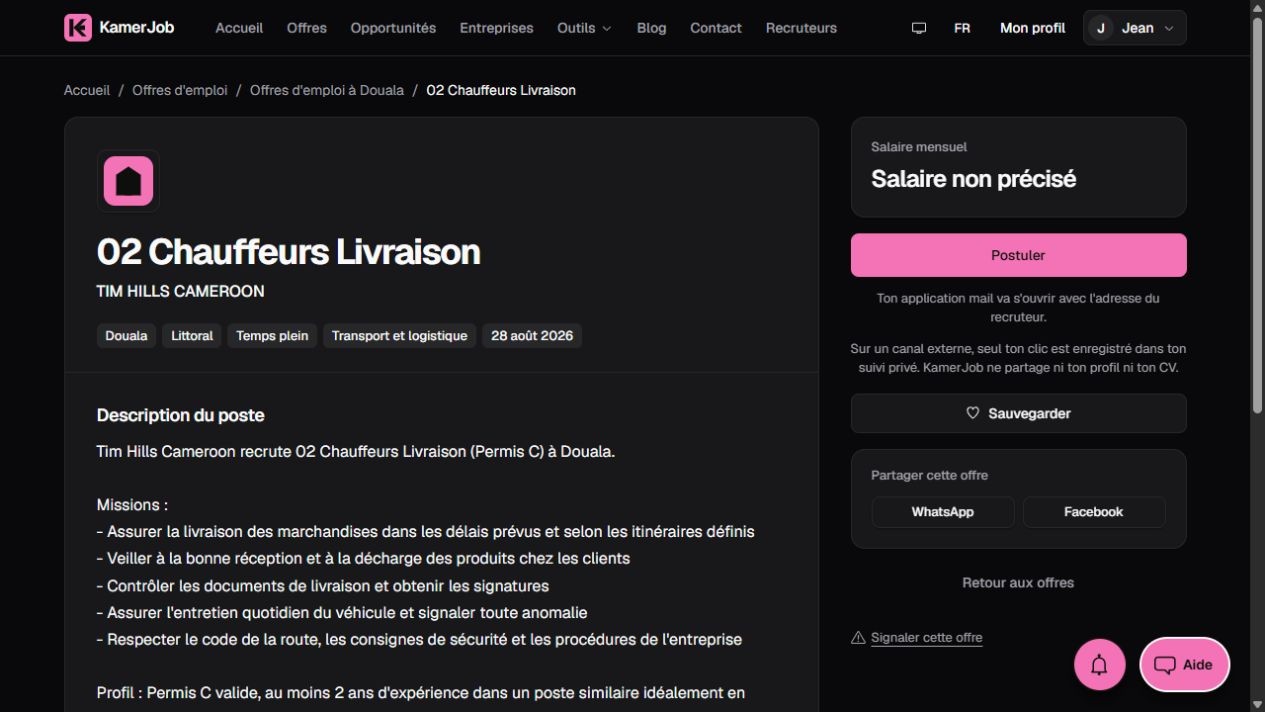
Kamerjob screenshot taken on 18 October 2026, in French, used for illustration. An older advert does not guarantee an open vacancy.
3. Describe experience through concrete duties
For each experience, give the role, employer or setting, town and dates. Add the vehicle type, areas covered and three or four responsibilities. Put the most recent experience first.
Personal driver — fictional example:
“Personal driver — [family or employer], [town], [month/year–month/year]. Drove [vehicle actually used] for daily journeys. Planned routes and met appointment times. Maintained vehicle cleanliness and reported faults to the supervisor. Respected the confidentiality of journeys.”
Delivery driver — fictional example:
“Delivery driver — [business], [town], [dates]. Delivered [products] across [areas]. Checked delivery notes against goods entrusted to me, collected signatures and returned paperwork. Reported delays or discrepancies to the supervisor. Performed vehicle checks following company procedures.”
Truck driver — fictional example:
“Truck driver — [business], [dates]. Drove [vehicle type] on [routes actually covered]. Maintained the journey log and handed over transport documents. Reported faults and coordinated with the operations team. Followed site and transport company safety instructions.”
Only include volumes, distances or results if reliable and explainable. Avoid absolute statements such as “no incidents” if you cannot substantiate them. Distinguish routine vehicle care from specialist mechanical repairs.
4. Present informal experience honestly
Have you driven for a family, a small business or occasional assignments? State that setting without inventing a contract or employer. For example: “Occasional driving assignments — [town], [period]: journeys for [context], route organisation and routine vehicle care”.
Specify the actual frequency if it helps explain your experience. Occasional assignments over two years do not automatically equal two years of full-time employment. If you are starting out, explain the skills gained and target suitable adverts without presenting personal driving as paid employment.

Illustrative photo: Muhammad-Taha Ibrahim / Pexels.
5. Include relevant skills and training
Select skills useful for the job: knowledge of specific neighbourhoods or roads, using a navigation app while stationary, reading delivery documents, maintaining a vehicle log and communicating with passengers or customers. List languages at your actual level.
For training, give the course title, provider and date. Do not describe a short awareness session as a professional certification. Ask a former supervisor’s permission before sharing their contact details as a referee; you can write “references available on request”.
6. Check the file before applying
- Are the dates, licence information and contact details accurate?
- Does the title match the vacancy?
- Are the vehicles and responsibilities clear?
- Is the CV readable on a phone, without tiny text?
- Does the file have a clear name such as “CV_Firstname_Lastname_Driver.pdf”?
The Kamerjob CV builder can help format your background. Read the final document carefully and keep an editable version to tailor future applications.
Browse driver vacancies and read our guide to starting your job search. A useful CV quickly shows a recruiter what you are authorised to drive and what you have actually done.
Cover: cottonbro studio / Pexels. Stock photos do not depict the fictional candidates or cited recruiters.
The Kamerjob team
Comments
Loading comments…