TikTok content creator: how to present your skills to a company

Do you create TikTok videos and want to work with a company? Your account can show creativity, but a recruiter also needs to understand what you can produce, your exact contribution and how you work towards an objective. Follower numbers alone do not explain these skills.
Here is how to turn your work into a portfolio and application, even with a small audience or no first client. The teaching examples and figures are fictional: replace them with verifiable details from your own work.
1. Describe the tasks you can perform
Replace “I know TikTok” with specific actions. A company may need videos to explain a service, introduce a product, document an event or answer customer questions. Identify what you actually do:
- Preparation: researching ideas and formats, writing scripts and planning shots.
- Filming: smartphone framing, sound, simple lighting, interviews or presenting to camera.
- Editing: selecting footage, pacing, proofread subtitles and exporting for the requested channel.
- Organisation: production schedules, following a brief, approvals and revisions.
- Analysis: interpreting available statistics and suggesting improvements.
These tasks reflect observable needs. For example, ZEDDO’s recruitment page for a September 2026 campaign in Yaoundé mentions filming, interviews and TikTok/Reels formats. This dated example illustrates a specific need; it does not mean the position remains open or all employers have the same requirements.
Introduction to adapt: “I plan and edit short videos using a smartphone. I write the script, organise shots and add subtitles. Here are three examples explaining my role and the objective.”
List tools you genuinely use and what you can do with each. Distinguish video production, community management and distribution to your own audience. One assignment may combine them, but the responsibilities should be clear.
Real vacancies published on Kamerjob: what evidence should you prepare?
The following examples were reviewed on Kamerjob on 18 October 2026. They help explain professional expectations without representing every employer or guaranteeing an ongoing recruitment process. Always check the vacancy status before applying.
Example 1: Videographer / Video Content Creator in Douala
The listing under Entreprise Automobile et Poids Lourds describes interviews, equipment presentations and editing for Reels, TikTok and YouTube. It requests Premiere Pro, CapCut and a video portfolio, with After Effects described as an advantage. At the time of review, the advertised deadline is 19 October 2026.
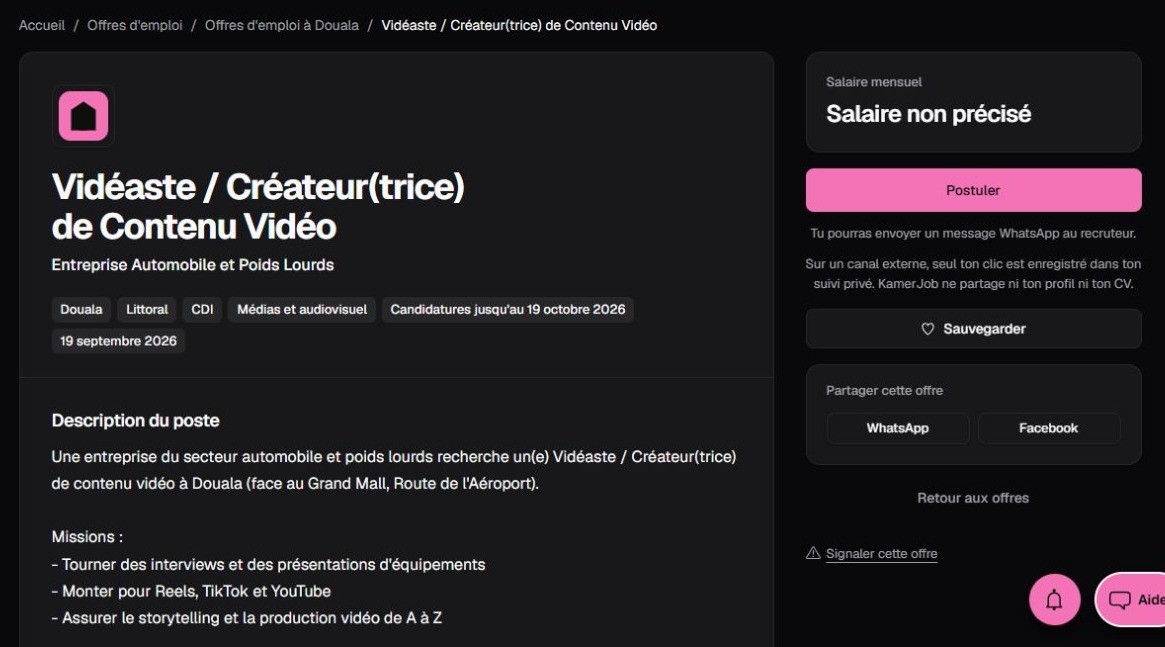
Actual screenshot captured on 18 October 2026. This vacancy may be closed by the time you read this article.
How to adapt your portfolio: prepare a short interview and a demonstration of an object or equipment you have permission to film. For each video, explain who wrote, filmed and edited it, and which tools you actually used. If you do not know Premiere Pro, do not claim it: state your level and assess whether you meet the requirements.
Example 2: Content Creator / Community Manager — FOGAY SERVICES SARL
This Douala vacancy is explicitly marked closed on Kamerjob at the time of review. It is retained as a learning example. It combines visual and written content, social media management, graphic design, organisation and visual judgement. The profile mentions Facebook, Instagram and TikTok.
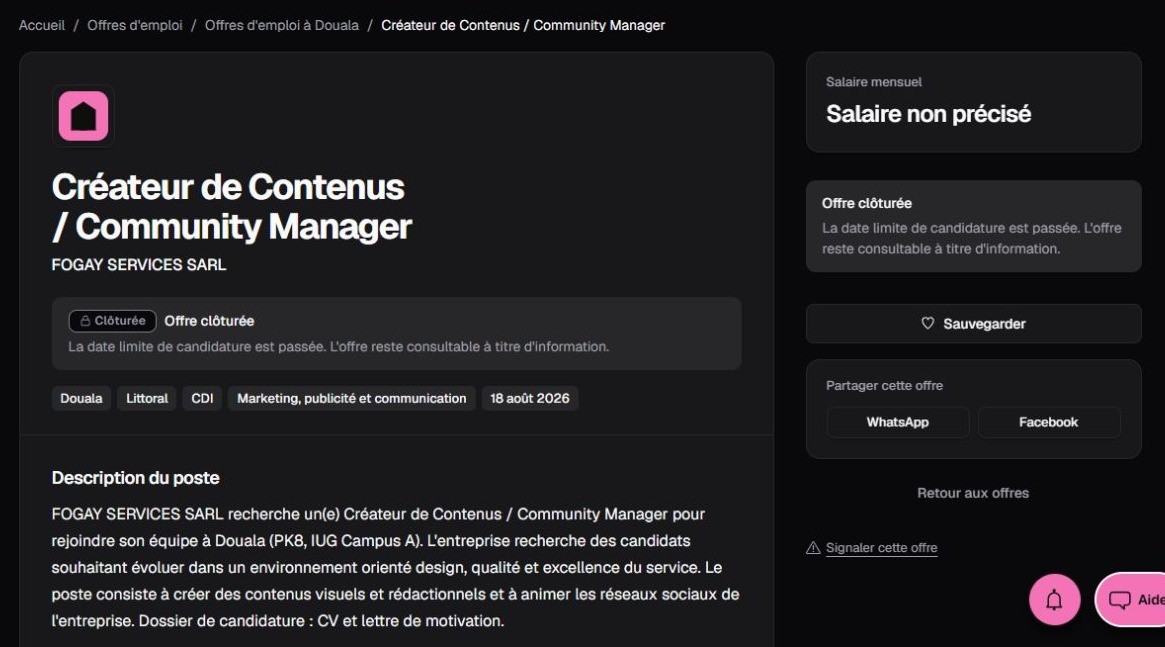
Expired vacancy: screenshot captured on 18 October 2026 to illustrate requested skills, not to invite applications.
How to adapt your application: bring together a video, a visual with its caption and a small editorial calendar. Label these as personal projects if they were not commissioned. This demonstrates consistent messaging across formats rather than simply reusing a popular sound.
Exercise: choose one listing, identify three duties and match each to evidence of your work. Also identify one skill to develop. The aim is to learn to read a vacancy, even after it has expired.
2. Build a portfolio of three to five examples
Select videos relevant to the company rather than sharing your entire account. Present them on a page or readable PDF, with links that do not require extra permission. Test the links on another device before sending.
For each video, explain the context, audience, objective, your contribution, constraints and what you learnt. If other people wrote, filmed or edited it, describe who did what.
Fictional project entry: “Personal project: demonstrating an accessory. Audience: people discovering the product. Objective: explain how to use it. My role: script, filming and editing. Constraint: smartphone and natural light. Improvement identified: show the product in use immediately instead of opening with a long logo sequence.”
No client yet? Prepare a demonstration project
Create three formats around something you own: a demonstration, an answer to a common question and a comparison of two uses. Clearly label it “personal project, not commissioned by the brand”. Do not invent a partnership or customer testimonial.
Use work you have permission to show and avoid exposing internal documents, contact details or faces without agreement. For music or images, check that the intended use is allowed: a sound available for personal use is not automatically appropriate for business communication.

A portfolio should make your method and deliverables easy to discuss. Illustrative photo: Christina Morillo / Pexels.
3. Explain results without confusing views with sales
Give the observation period, source and context for available results. State whether the video received paid promotion. Views, comments and shares describe interactions; they do not independently establish sales or profitability.
Fictional example: “In the seven days after publication, this video recorded 4,200 views and 35 shares in the account statistics. It received no paid promotion. I do not have sales tracking, so I cannot attribute revenue to this video.”
If reliable statistics are unavailable, say so and explain your process: different openings tested, subtitles corrected, a deadline met or a misunderstanding resolved. Hide private information in analytics screenshots and obtain the client’s agreement before sharing them.
Show how you select a trend
Do not promise to “make the brand go viral”. Explain your selection instead: does the format suit the audience, message and company tone? Can people understand it without knowing the trend? Is it appropriate to use in this context?
Fictional example: for a shop in Douala, you suggest a “customer question → demonstration → practical information” format to explain available sizes. You justify it through clarity, without guaranteeing reach. Trends change: date your research instead of presenting a format as a permanent winning formula.
4. Tailor your CV and application to the vacancy
On Kamerjob, try searches such as “content creator”, “video editor” or “community manager”, including their French equivalents. Read the duties: some roles focus on filming, others on editing or managing posts. Check requirements and conditions before applying.
Your CV can include “Short-form video creation — personal projects”, followed by two or three tasks you actually perform. Add a portfolio link and your working languages with an honest assessment of your level.
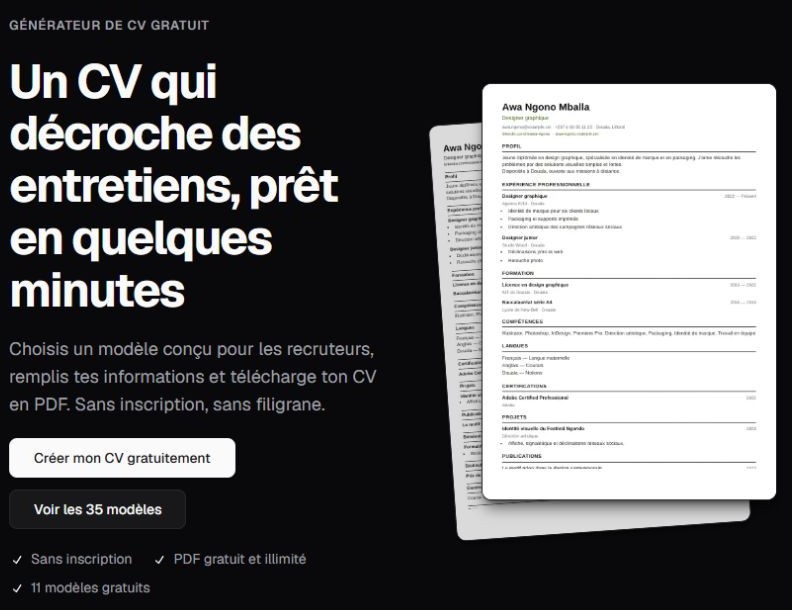
Kamerjob screenshot captured on 17 October 2026: the CV builder can help structure your background. The layout may change.
Application message: “Hello [name], I am applying for the [job title and reference] position. I carry out [two tasks relevant to the advert]. My portfolio presents [type of work] and explains my role: [link]. I am available from [date] in [town]. Please find my CV attached. Thank you.”
Follow the requested application channel. Use WhatsApp only if the advert or recruiter allows it. To prepare for the conversation, see our first job interview guide.
5. Be ready to explain your approach
In an interview, choose one project and explain the need, your decisions, difficulties and next improvement. For a test assignment, clarify the brief, deadline, number of videos, expected revisions and intended use. Work intended for publication deserves clearly agreed arrangements.
Useful question: “To prepare the proposal, could you clarify the audience, main message, materials provided, person responsible for approval and intended use of the video?”
Before a project begins, also clarify whether publication will be on your account or the company’s, required access, equipment, travel and payment. Do not share personal passwords to demonstrate your portfolio.
Do this today: select three videos, write an entry for each, check your links and prepare a short introduction. Your application will then demonstrate what you can deliver and how you work, beyond follower numbers.
Occupational source consulted on 18 October 2026: the official ZEDDO page linked above. Illustrative photos: George Milton / Pexels and Christina Morillo / Pexels. The people pictured are not presented as Kamerjob candidates or employees. Screenshot: Kamerjob.
Cover photograph: George Milton / Pexels. Illustrative image.
The Kamerjob team
Comments
Loading comments…