How to Write a CV in Cameroon That Grabs Recruiters' Attention

A Cameroonian recruiter spends on average less than 40 seconds on a first read of a CV. When a vacancy posted in Yaoundé or Douala attracts 200, 300, sometimes 500 applications, your CV has only one job: to survive that first sift. The good news? The vast majority of CVs sent in Cameroon make the same mistakes. Avoid them and you automatically move ahead of dozens of candidates.
In this guide, we show you exactly how to write a CV in Cameroon that grabs recruiters' attention, section by section, including the local-market specifics that foreign guides overlook.
What Cameroonian recruiters look at first
Before you start writing, you need to understand how your CV will be read. Recruiters in Cameroon — whether at an HR consultancy in Douala, an SME, an international NGO or a multinational — scan it quickly in this order:
- Your current or most recent job: does it match the vacancy?
- Your qualifications and institution: do you meet the required level?
- Your years of experience: do you have enough?
- The overall presentation: is the document clean, readable and professional?
Everything else — your hobbies, your references, your full address — comes much later, if the recruiter gets that far. Your CV must therefore make these four pieces of information visible within seconds.
The ideal CV structure in Cameroon
1. The header: simple and complete
Your header should include: your full name, a professional title (e.g. "Senior Accountant — 6 years' experience"), a phone number (say if it is reachable on WhatsApp), a professional email address and your town of residence.
The professional title under your name is the most neglected element, yet the most powerful: it lets the recruiter place you instantly. Tailor it to each vacancy.
An email address such as bogosse237@… or jolimane… disqualifies you immediately. Create a sober address: [email protected].
2. The profile or summary: 3 to 4 lines that sell
Just below the header, write a short paragraph that answers the recruiter's question: "Why this candidate and not another?"
Bad example: "Dynamic and motivated young person looking for a job in a serious company." This sentence says nothing and appears on thousands of CVs.
Good example: "Administrative assistant with 4 years' experience in SMEs in Douala. Proficient in invoicing, CNPS follow-up and Microsoft Office. Bilingual French–English."
3. Work experience: results, not tasks
List your experience from the most recent to the oldest. For each job: title, company, town, dates, then 3 to 5 bullet points describing your achievements.
The difference between an average CV and one that lands the interview comes down to one word: figures.
- Average: "Responsible for stock management"
- Strong: "Managed a stock of 2,000 items; cut stock-outs by 30% in one year"
- Average: "Sold products in a shop"
- Strong: "Achieved average monthly sales of 4.5 million FCFA, 15% above target"
Even without precise figures, quantify what you can: size of the team you supervised, number of clients you handled, budget managed, how often you produced reports.
A special case: internships and informal work. If you are just starting out, highlight your internships, student jobs and even informal activities (trading, call-box, private tutoring), presenting them just as seriously: skills used, results achieved. A recruiter prefers a candidate who has "done something" to an empty CV.
4. Education: qualifications and institutions
List your qualifications from the most recent to the oldest: exact title, institution, town, year obtained. In Cameroon, the name of the institution matters, so always include it (University of Yaoundé II, ESSEC Douala, IUT, ENSP, etc.).
If you hold a foreign degree or an online certification (Google, Coursera, OpenClassrooms), list it: digital certifications are increasingly valued, especially in tech, digital marketing and finance.
5. Skills: targeted and verifiable
List 6 to 10 skills at most, directly related to the vacancy. Separate them into:
- Technical skills: software (Excel, Sage, SAP…), programming languages, machinery, procedures (CNPS declarations, DSF, public procurement…)
- Languages: in Cameroon, French–English bilingualism is a major competitive advantage. Be honest about your level (fluent, intermediate, basic) — it will be tested at interview. National languages can be an asset for field roles.
Avoid empty buzzwords ("dynamism", "punctuality"): they add nothing.
6. Optional sections
- Interests: only if they add something (club sport = team spirit, association = leadership).
- References: "References available on request" is enough. Never list your former employers' phone numbers without their consent.
7 mistakes that get your CV rejected in Cameroon
- A CV longer than 2 pages. One page if you have less than 5 years' experience, two pages at most beyond that. Nobody reads a 4-page CV.
- An unprofessional photo. If you include a photo (common in Cameroon, but not compulsory), it must be recent, sober and on a neutral background. No selfies, no cropped ceremony photos.
- Spelling mistakes. This is the number one reason for rejection for administrative roles. Have someone else proofread your CV.
- Irrelevant information. ID card number, marital status, number of children, parents' names: none of this belongs on a modern CV.
- One CV sent everywhere. A generic CV is spotted immediately. Tailor the title, profile and skills to each vacancy — 15 minutes that make all the difference.
- Lying. Fake qualifications and fake experience are routinely checked by structured companies, and the Cameroonian job market is small: your reputation follows you.
- A cluttered layout. Three colours, five fonts, tables everywhere: the recruiter can no longer see the information. Keep it sober, structured and airy.
The format: always PDF
Always send your CV as a PDF, never as a Word file: the layout stays intact on every device, including mobile — where most Cameroonian recruiters now read applications. Name the file properly: CV_SURNAME_Firstname_Position.pdf, not cv final version 2 (1).pdf.
Practical example: create and tailor your CV in Kamerjob
Open the Kamerjob CV builder. Choose the free creation button or browse the templates. The screenshot below shows the French interface.
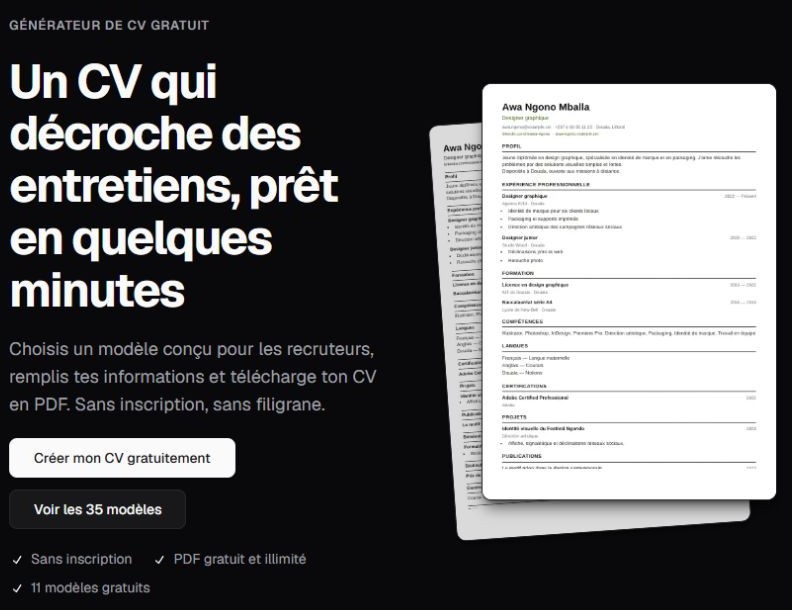
- Choose a readable free template and enter your contact details and target position.
- Tailor your profile, experience and skills to the job description using only accurate information.
- Check the preview, download your document and open it to verify dates, layout and contact details.
Fictional example: replace a vague task such as “Stock management” with “Received deliveries, organised items by reference and helped with stock counts”, if these are tasks you actually performed. Add tools or measured results only when you can support them.
Kamerjob screenshot taken on 17 October 2026. The landing-page CV is a sample. The interface and available templates may change.
Is your CV ready? Take action
An excellent CV is useless if it never meets the right vacancies. On Kamerjob, find hundreds of verified job offers every day in Yaoundé, Douala and across Cameroon, in every sector. Create your profile, apply directly online and give yourself every chance of success.
Article published by the Kamerjob team — Cameroon's leading job platform.
Comments
Loading comments…