How to Write a CV With No Diploma or Formal Work Experience

You need to send a CV, but you have no diploma and no formal work experience to put on it? You can prepare a useful application without inventing a background. The most important thing is to explain what you can do, what you have already done and the job you are looking for.
Helping in a family business, taking part in organising an event, learning from a craftsman or doing odd jobs may have given you skills. Even if you have never signed a contract, some of these activities deserve to be described. Here is how to write a CV with no diploma or formal work experience, with examples and a template adapted to Cameroon.
The right starting point: your CV presents your current abilities. It does not need to tell a perfect story to be clear, honest and interesting.
1. Take stock of what you can do
Before choosing a layout, take a notebook or your phone. Write down the activities you have actually done, even occasionally. You can also describe them to someone you trust who will help you write them down.
- Have you welcomed customers, tidied a shop or prepared orders?
- Have you cooked for an event, cleaned premises or helped set up equipment?
- Have you learned skills in tailoring, hairdressing, mechanics or another trade?
- Have you taken part in an association, a neighbourhood activity or a personal project?
- Can you use a phone to send a document, follow a schedule or communicate with customers?
For each activity, specify three things: what you did, in what setting and when. Add how often if you know it: a few weekends, two mornings a week or during the holidays.
If you have not yet done anything related to the job, keep it simple. Present your goal, your availability and what you are ready to learn. Don't make up an activity to fill the page.
2. Choose sections that highlight your abilities
Your name and contact details
Give your name, a phone number where you can be reached and your town or neighbourhood. Add an email address if you check it. Check every digit: a wrong number can stop the recruiter from contacting you.
For a first contact, your town and neighbourhood may be enough. Avoid adding your national ID card number, your personal codes or information unrelated to the application.
A title that matches the job
Replace "Curriculum vitae" or "Looking for work" with a precise goal: "Entry-level shop assistant", "Entry-level cleaner" or "Application for a tailoring apprenticeship". Choose a title that matches your abilities and the job ad.
A two- or three-sentence introduction
Explain what you are looking for and what you can bring. For example: "I am looking for a shop assistant job in Douala. I helped with tidying and welcoming customers in a family shop. I am available Monday to Saturday." Only use this example if this information matches your situation.
Your skills, with examples
Prefer "arranging products by category" to "very competent". Instead of listing "serious, dynamic, motivated", describe a real habit: keeping to an agreed schedule, checking quantities or cleaning equipment after use.
Adapt this list to the job. For kitchen work, detail the cooking tasks you have mastered. For sales, present your ability to welcome customers, arrange stock or count. Only list a technical or digital skill if you can demonstrate it.
Your activities and learning
You can call this section "Practical activities and informal experience". State the setting: family help, volunteering, personal project or apprenticeship. Unpaid work can be valuable; it must still be presented as what it is.
For schooling, give your actual level if it helps explain your background. For example: "Schooling up to Form 4 (classe de troisième), no certificate obtained". If you did not go to school, don't create an empty section. You can present what you have learned in practice. If the recruiter asks about your level, answer accurately.
3. Turn your activities into concrete descriptions
The following wordings are examples to adapt. Keep only the tasks you have actually done.
- "I used to help my aunt at the shop" becomes: "Support in a family shop: welcoming customers, arranging products and helping count deliveries."
- "I helped out at ceremonies" becomes: "Occasional help organising events: setting up tables, serving and tidying up after receptions."
- "I do a bit of sewing" becomes: "Personal sewing practice: making [alterations or items actually made] and using [tool you have mastered]."
Add the real dates. If you no longer remember the exact month, use a year or an approximate period, clearly marked as such. Don't turn occasional help into a full-time job.
A few photos of your work can complement an application for a manual trade. Ask the people concerned for their consent before sharing their images or contact details. A referee must be someone who knows your work and agrees to be contacted.

Start by writing down your activities and skills before drafting your CV. Illustrative photo: Monstera Production / Pexels.
4. A no-diploma CV template to fill in
This template is a structure, not a background to copy. Replace the items in square brackets and delete the lines that don't apply to you. One clear page can be enough.
[FIRST NAME AND SURNAME]
[Town, neighbourhood] — [Phone] — [Email, if available]
POSITION SOUGHT
[Precise title of the job or apprenticeship]
PROFILE
I am looking for [type of job] in [town]. I can [one or two tasks you have mastered]. I would like to [concrete career goal].
SKILLS
- [Task you have actually mastered]
- [Tool or method you know how to use]
- [Work habit illustrated by an example]
PRACTICAL ACTIVITIES AND INFORMAL EXPERIENCE
[Period] — [Activity and actual setting: family help, volunteering, personal project…]
- [Task performed]
- [Other task performed]
APPRENTICESHIPS OR SCHOOLING
[Practical apprenticeship, training actually completed or exact school level; delete this section if it adds nothing]
LANGUAGES AND AVAILABILITY
[Languages and actual level] — [Available days and hours] — [Area you can travel to]
If you have no activity to mention, remove the corresponding section. Expand on the skills you can explain and on what you want to learn. A short, accurate CV is better than a page full of fake experience.
For a more detailed presentation of the general structure, see our guide to writing a CV in Cameroon.
Try it on Kamerjob: turn your outline into a CV
Open the Kamerjob CV builder and choose Build my CV for free. You can start without importing an old CV.
Inside the editor: where to enter your background
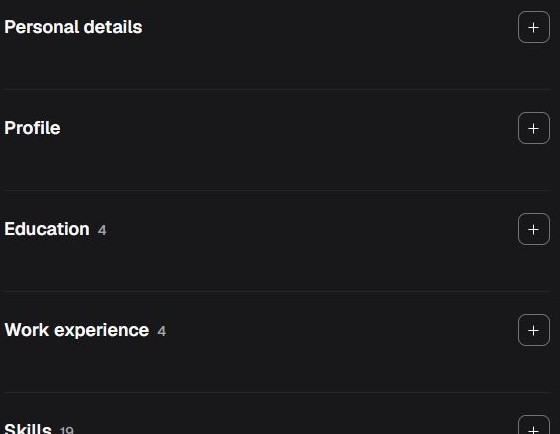
Cropped editor screenshot: open each section using the “+” sign. There is no required number of qualifications or experiences.
- Personal details: enter your relevant contact details and target position. Check your phone number and email address.
- Profile: explain your goal and two genuine abilities in a few lines.
- Education: describe the schooling you actually attended and make clear when no qualification was obtained. Do not invent a certificate to fill a box.
- Work experience: describe relevant activities and their dates, clearly identifying family support, volunteering or occasional work. The section’s name does not turn those activities into paid employment.
- Skills and Languages: include only abilities you can demonstrate and your actual level. Look for “Projects” or “Volunteering” too if they match your background.
Fictional example: Amina sometimes helped at a family shop on Saturdays without an employment contract. She could describe “Occasional support in a family shop: arranging shelves and welcoming customers”, with her actual dates. She should not call herself a sales manager if that was not her role. Replace this example with your own activities.
Choose a template and download the CV
Open Templates in the formatting toolbar. The panel includes a job or keyword search and filters for style, price and compatibility. Under Price, choose Free to find templates available without a Premium plan. Meridian was one free template visible when we checked.

Review the preview, then use Download. Open the resulting PDF and check contact details, dates, spelling and layout before sending it. A Premium template may be available to try in the editor without being free to download: check the displayed price.
Language: “CV language” sets the document’s section headings independently of the website language. Translate and proofread your own text too: changing headings alone does not translate your background.
Kamerjob screenshots from 18 October 2026, cropped to the controls to protect personal information. Buttons and layout may vary by device or change over time. Replace the guide’s examples with your own truthful details.
5. Proofread, send and prepare for what comes next
Checks before sending
- The job: does your title match the application?
- The content: can you explain every skill and every activity?
- The dates: are the periods and frequency consistent?
- Readability: is the text easy to read on a phone, without characters that are too small?
- Contact: are your number and email correct?
- The file: does the document open properly, and does it have a clear name, such as "CV_Firstname_Surname_ShopAssistant.pdf"?
Follow the format requested in the ad. If no format is specified, a PDF usually keeps the layout intact. Open it after exporting and check that no line has been cut off. If a photo is requested, use your own portrait, never a stock photo.
A short message to go with your CV
Hello, please find my application for the [job] position in [place]. My CV is attached. I am available to discuss my skills and the conditions of the job. Thank you for your attention. [First name and surname]
Check that the file is actually attached. If someone helps you write it, reread every line together and keep a copy. You must be able to explain your CV in your own words at the interview.
You can start today: choose a job, list three real abilities and fill in the template. Then browse the job offers on Kamerjob, checking the requirements of each ad. To broaden your search, read our article Finding a job without a diploma in Cameroon.
Your CV does not have to hide your background. It should help the recruiter understand your starting point, what you can already do and what you want to learn.
Photo credits: Edmond Dantès / Pexels (cover) and Monstera Production / Pexels. Illustrative photos: they say nothing about the level of education or career of the people shown.
The Kamerjob team
Comments
Loading comments…